
WINERIES
【Exclusive Interview with Takahiko Soga of Domaine Takahiko】“There Are Wines That Can Only Be Made in Japan” — Takahiko Soga on Nature, Deliciousness, and the Future of Japanese Wine
Contents
- 01Takahiko Soga on the Distance Between Wine and Nature
- 02“Let Us Do What Countries Without Rain Cannot Imitate”
- 03Harnessing Japan’s Microbial Environment in Winemaking
- 04Showing for Himself That It Can Succeed on the World Stage
- 05“I Think Natural Wine in Japan Is About Deliciousness”
- 06How Should We Enjoy Japan’s Natural Wines?
The term “natural wine” has become widely recognized, and in Japan it has many devoted fans; wine shops and restaurants now often treat it as a category of its own.
There is no single, unified definition of natural wine, but it is often understood through production choices such as wild yeast, no filtration or fining, restrained use of sulfur dioxide, and organic farming.
Yet winemaking methods are only the process. What, then, are the producers ultimately trying to achieve beyond those methods?
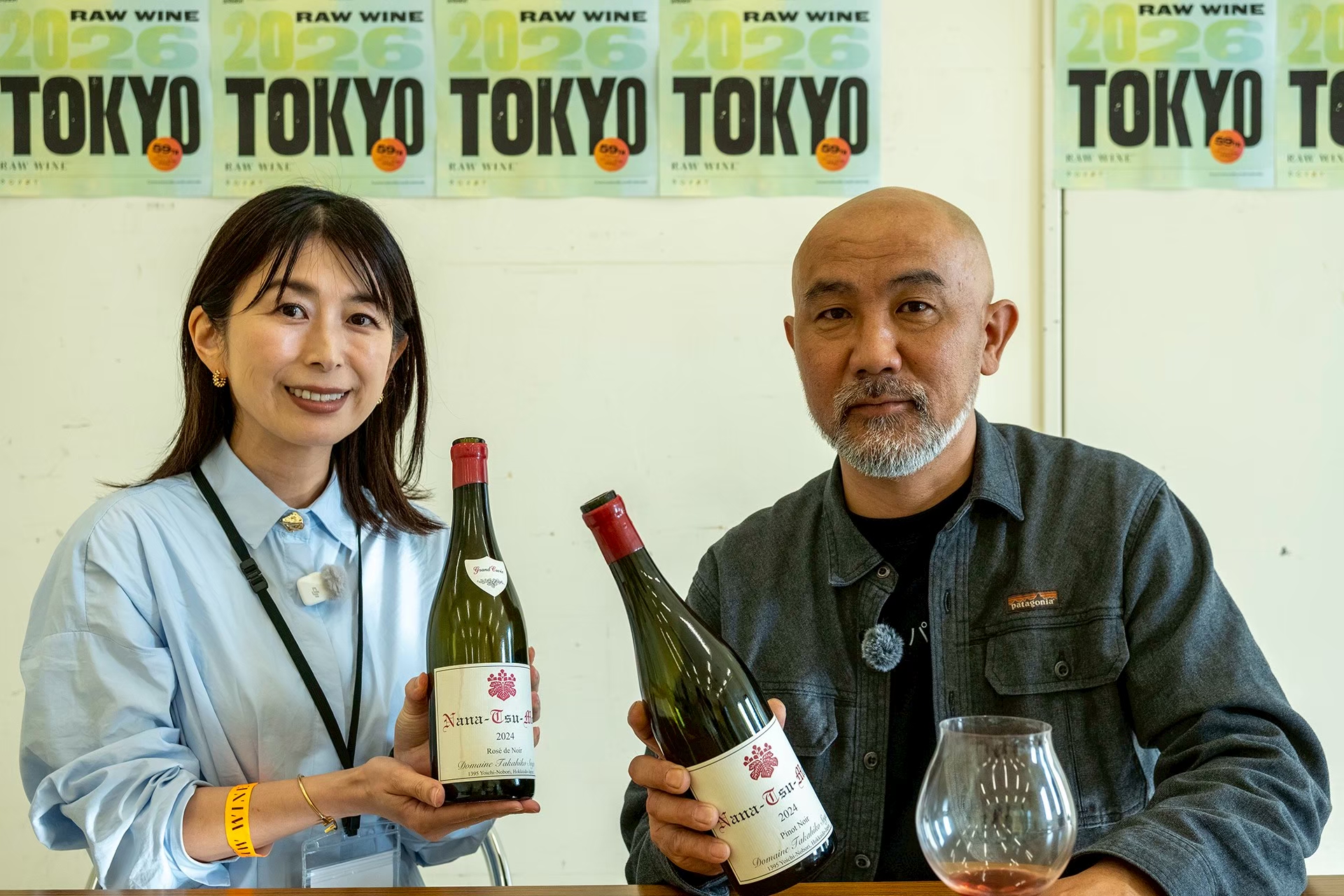
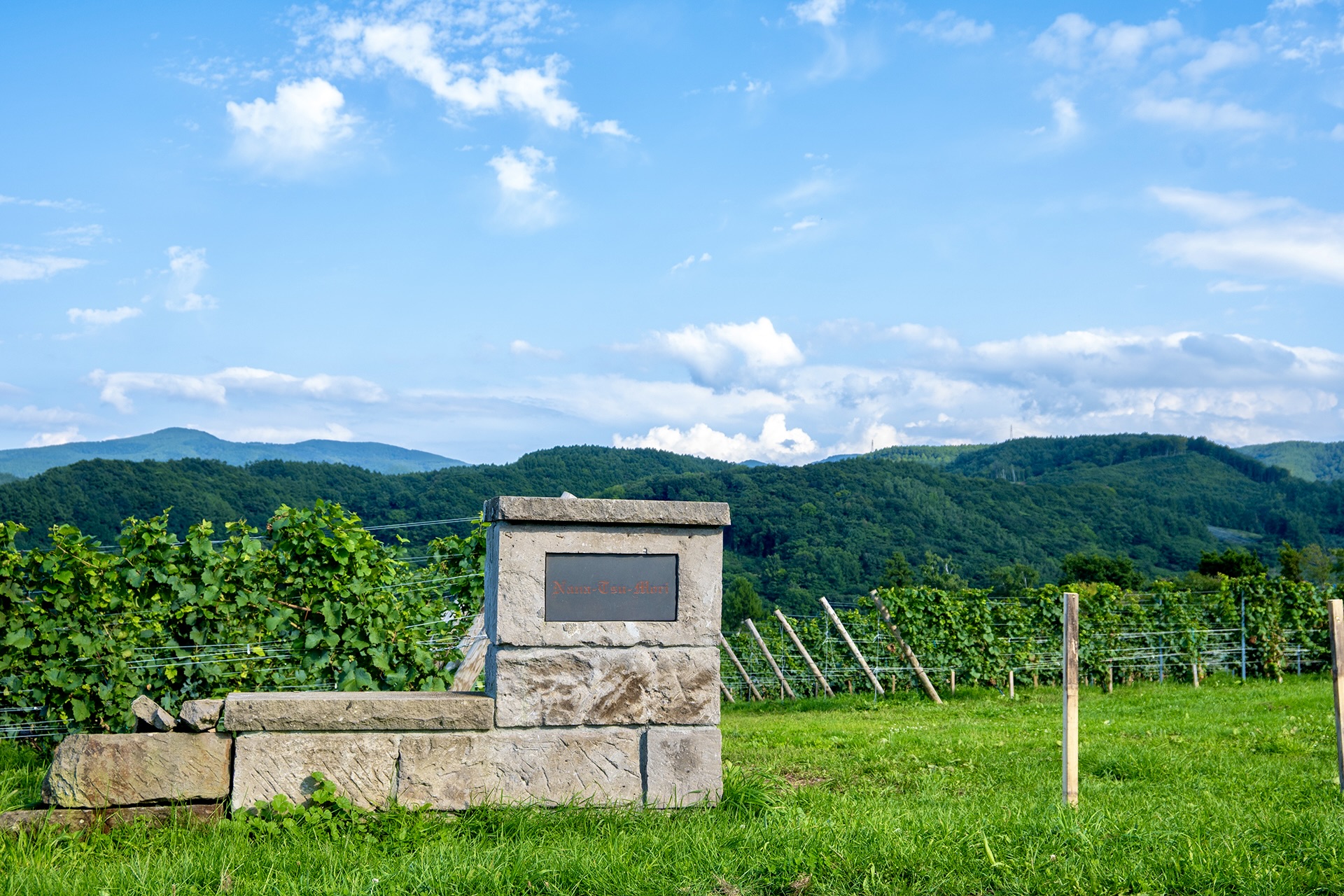
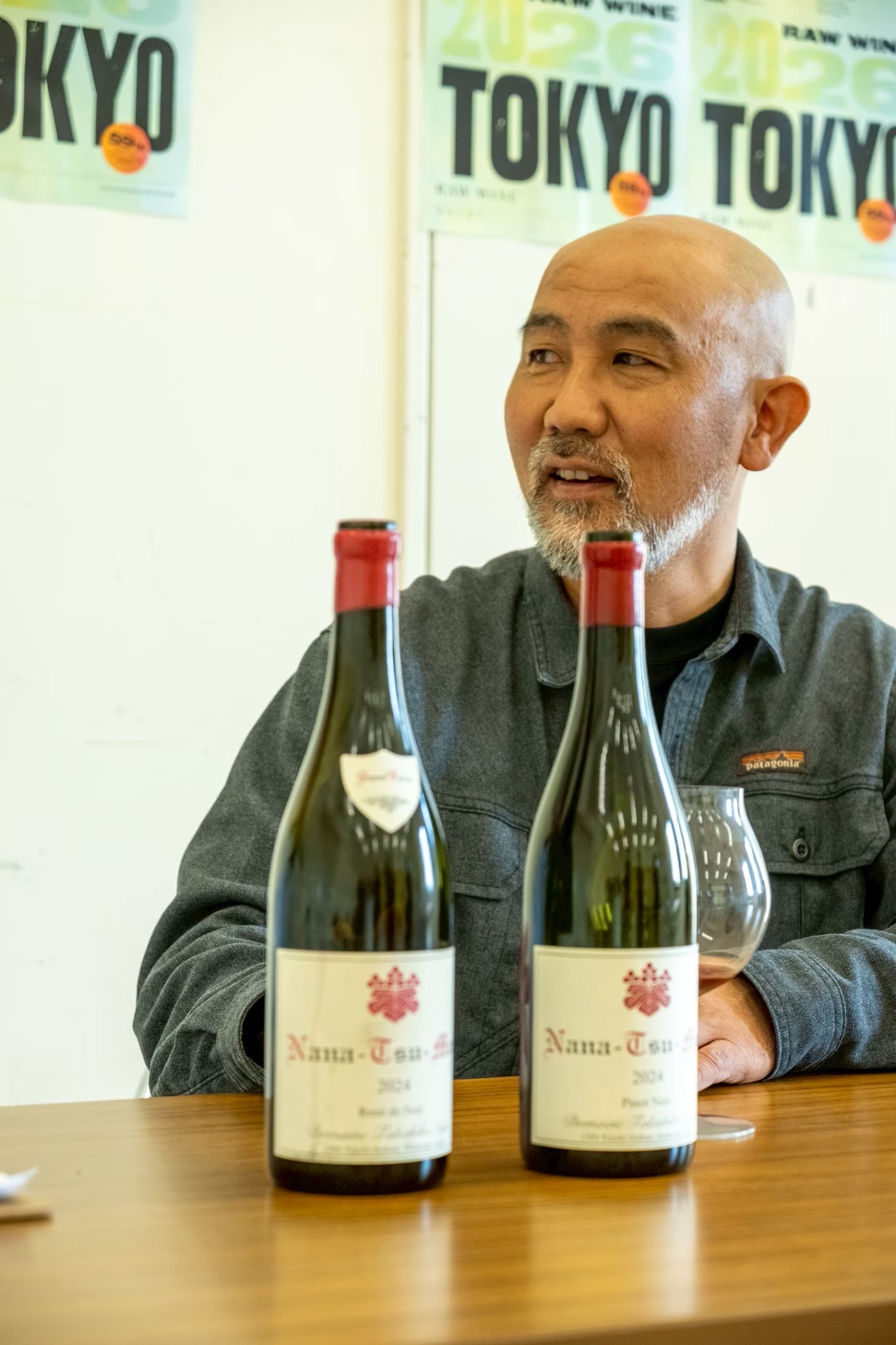
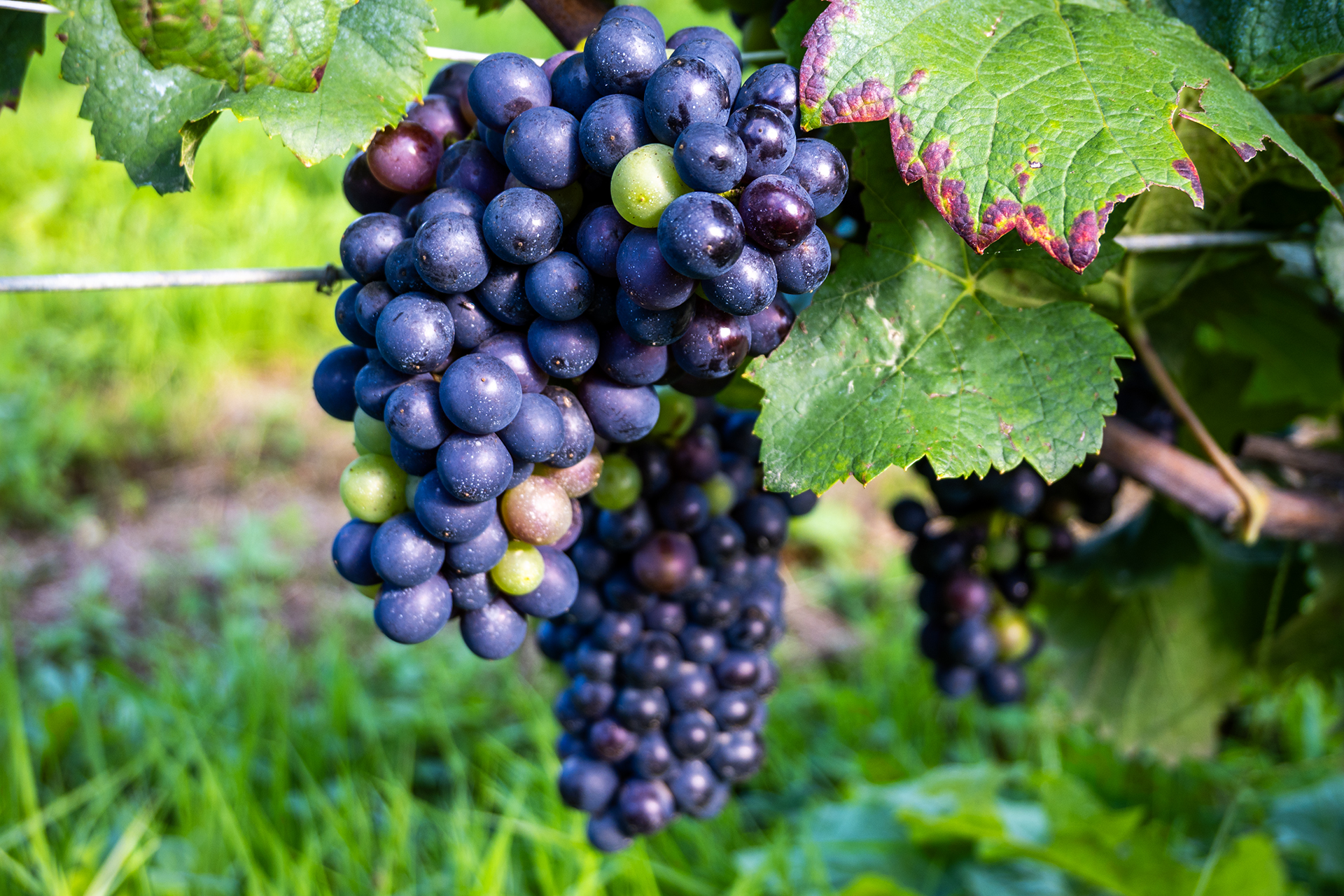
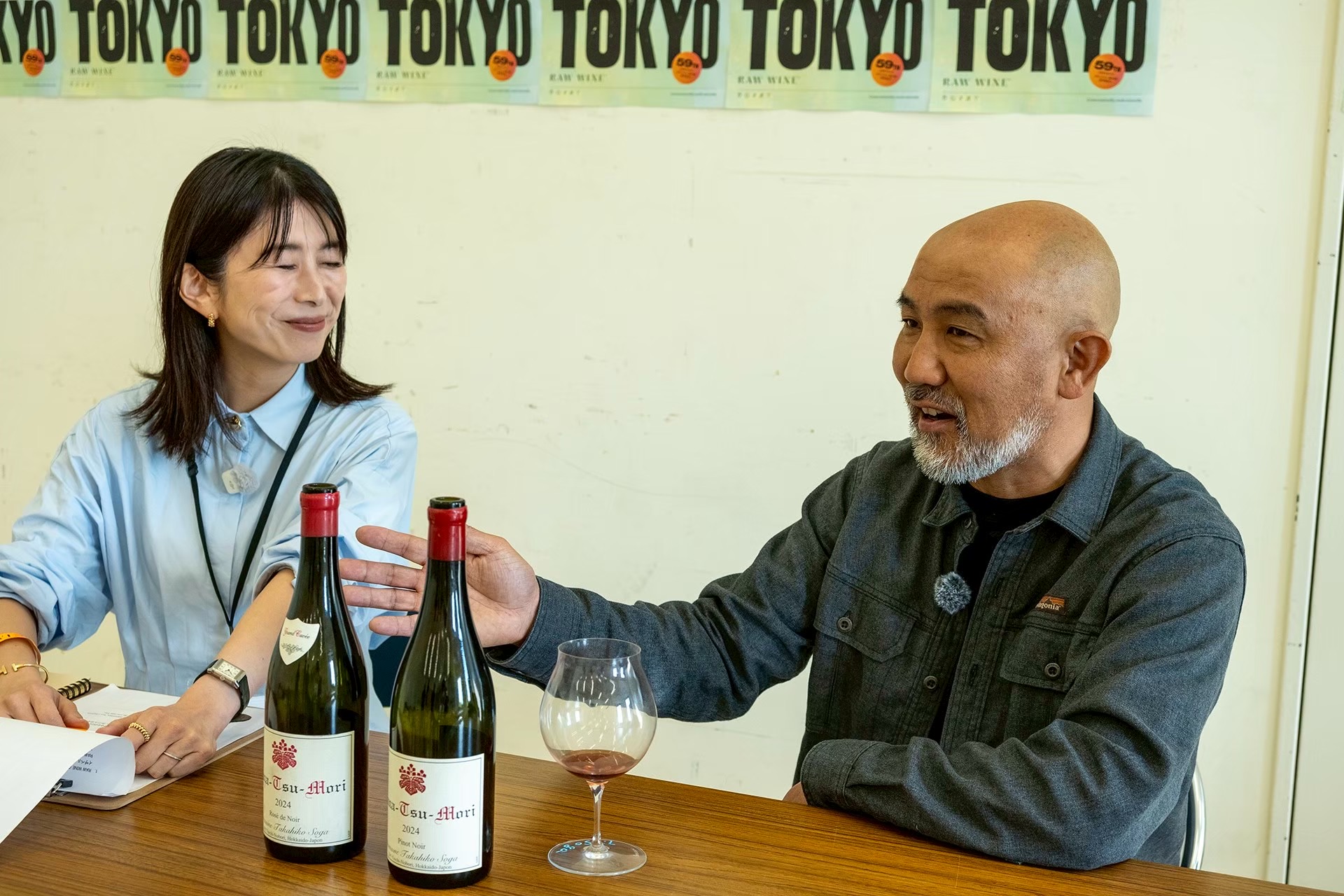
At RAW WINE TOKYO, I spoke with Takahiko Soga, who runs Domaine Takahiko in the Nobori district of Yoichi, Hokkaido. He grows Pinot Noir on approximately 4.6 hectares of farmland and continues to make wine centered on wild yeast and whole-cluster fermentation. His flagship “Nanatsumori Pinot Noir” has earned high acclaim both in Japan and overseas and is now one of the most difficult Japanese wines to obtain.
Organic farming, wild yeast, whole-cluster fermentation... Looking only at Soga’s winemaking style, some might see him as one of the producers who epitomize natural wine.
But Soga himself said, “I don’t want to be called part of the ‘natural’ camp.”
CHAPTER 01
Takahiko Soga on the Distance Between Wine and Nature
Of course, Soga is not rejecting natural wine itself. Rather, listening to him, I sense that precisely because he has thought so deeply about nature, the environment, and microorganisms, he is cautious about grouping wine under the single label “natural.”
“We should move toward each other,” he said. He does not seem to find much meaning in setting conventional and natural wine in opposition.
After all, agriculture is inherently an activity in which people intervene in nature. If only doing nothing can be called “natural,” then a vineyard itself would not be natural.
Mitsuhiro Anzo, Executive Winemaker at Château Mercian, has also often addressed the relationship between nature and people in seminars, saying that “rural landscapes, for example, have been created through the joint work of nature and human beings.” People have worked upon mountains, forests, and other natural environments, faced nature and at times struggled against it to create fields, and lived from the bounty those fields provide. Even the countryside scenes we describe as “rich in nature” have in fact been shaped through this long history of human activity.
Seen this way, perhaps what matters is not a simple dividing line between whether human hands are involved or not, but how people engage with nature, and how far they choose to intervene.
Soga continues to search for his own answer in the vineyard and in his wines. In fact, beginning with the 2023 vintage, Domaine Takahiko has used a small amount of sulfur dioxide even in its red wines, taking the effects of climate change into account.
Rather than prioritizing a rule that says, “we don’t use it because this is natural wine,” he makes decisions by observing the grapes and the state of fermentation in each vintage. What lies behind that approach seems less about protecting a category than about choosing what is necessary to make better wine.
And the word Soga returned to again and again was an extraordinarily simple one: “deliciousness.”
Natural Wine Needs Science Precisely Because It Is Natural
While Soga places great importance on “nature,” he never distances himself from science.
It is not a matter of saying, “because we make wine naturally, we don’t need science.” On the contrary, precisely because you are working with nature, when something goes wrong you need to ask why. Using wild yeast does not mean simply leaving fermentation to nature. You must observe the condition of the microorganisms and read the changes taking place.
Nature and science. Moving back and forth between two things that may appear to be opposites, Soga works toward the taste he seeks. The more I listened, the clearer it became why his wines cannot be contained by the phrase “natural wine” alone.
CHAPTER 02
“Let Us Do What Countries Without Rain Cannot Imitate”
From there, the conversation moved from natural wine to the meaning of making wine in Japan.
When Japan is discussed as a wine-producing country, its abundant rainfall and high humidity are generally treated as disadvantages. Rainfall is high and disease pressure is significant. There is no question that it is not an easy environment in which to grow wine grapes.
Yet Soga says with confidence, “We can do things that countries where it doesn’t rain simply cannot imitate.”
Soga says that when he was younger, he was drawn to the idea that “great wine comes from poor soils.” But as he traveled through wine regions around the world and tasted many different wines, he began to feel that the wines he loved were connected not only to the “method”—whether they were organic or not—but to the “place” itself.
“The places that produce wines that move me have rain, forests, and life.” Burgundy, Jura, and northern Italy are examples.
Rain falls, plants grow, and the soil is inhabited by diverse forms of life and microorganisms. Soga sees distinctly Japanese potential in that entire environment.
CHAPTER 03
Harnessing Japan’s Microbial Environment in Winemaking
Soga has a background in microbiological research.
Japan has long had a diverse culture of fermentation, including sake, miso, soy sauce, vinegar, and pickles. It could be said that people here have built a distinctive food culture by living alongside microorganisms in a humid climate.
So rather than simply importing the same methods used in dry wine regions, why not make use of Japan’s rich microbial environment in winemaking? His commitment to fermentation with wild yeast seems to be connected to an idea that goes beyond the method itself: how to carry the microorganisms present in the vineyard from the grapes into the winery and through fermentation.
Seen as a possibility for a uniquely Japanese style of wine, this is a particularly fascinating perspective for Japanese wine, which has long looked to European wine as one of its principal benchmarks.
Rather than lamenting that Japan does not share the same conditions as the world’s renowned wine regions, Soga values what can be created precisely because the conditions are different. Rain, humidity, microorganisms—things that have long been described as weaknesses begin, through his words, to look like part of Japanese wine’s individuality.
CHAPTER 04
Showing for Himself That It Can Succeed on the World Stage
Soga’s wines are now highly regarded overseas as well. I asked why he sends abroad wines that are already scarce even within Japan. “People used to say that Japanese wine made with wild yeast and as little sulfur dioxide as possible could never compete internationally. So I thought, then I’ll show them that it can.”
His goal is not for his wines alone to succeed overseas. By creating one real example, he can make it easier for Japanese producers who follow to take on the same challenge—and, in turn, raise the value of Japanese wine as a whole.
This overlaps with the idea of “being able to continue” that he speaks about in relation to agriculture. I have also heard him describe his own winemaking several times as being “like pickles that anyone can make.”
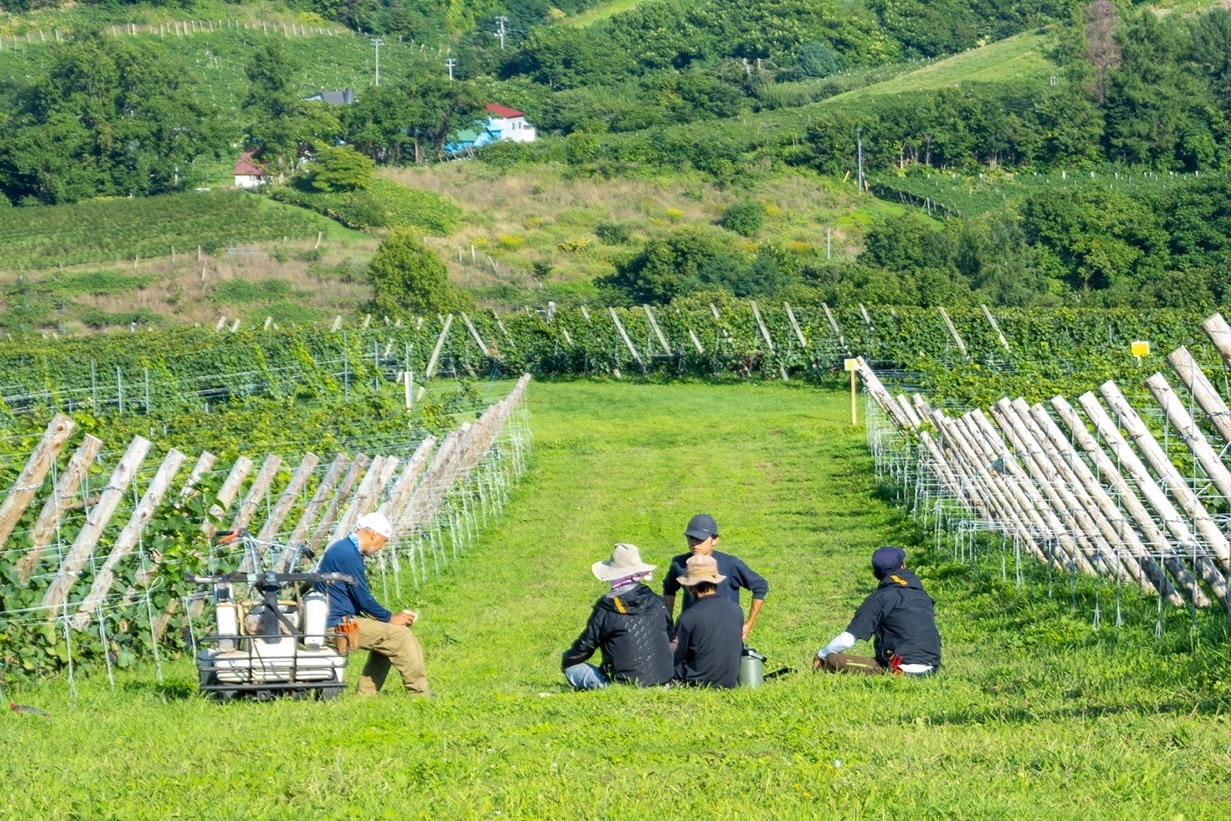
A special method that only one person can practice will not remain rooted in a region. If neighboring farmers can put it into practice, pass it to the next generation, and gradually spread it through the community, then a wine culture can take root in the land. Rather than producing a single star winemaker, that seems to be the future Soga is looking toward.
CHAPTER 05
“I Think Natural Wine in Japan Is About Deliciousness”
This interview took place at RAW WINE TOKYO, a festival devoted to natural wine.
I asked him, “If you had to describe Japanese natural wine in a single phrase, what would it be?” Soga replied, “Globally, it is often discussed in the context of the environment or ecology, but I think that in Japan, it is about deliciousness.” He continued, “If you pursue deliciousness, the environment and nature will follow.”
Not “because it is organic” or “because it uses wild yeast,” but first and foremost because you want to make delicious wine. That requires good grapes. To grow good grapes, you look at the soil. When you look at the soil, you look at the microorganisms. And inevitably, you must engage with the natural environment of that place.
In other words, rather than turning the protection of nature or a particular method into the “rules” of winemaking, the pursuit of deliciousness itself can lead you toward a better relationship with nature and toward the methods best suited to that place.
The wines Soga seeks are not so much dense and powerful as delicate yet deep, with a long finish. He describes that quality as an “umami” like fine Japanese dashi broth.
Japanese people creating their own sense of deliciousness from Japan’s climate and landscape may ultimately produce flavors that fit naturally at the Japanese table. And that does not conflict with being appreciated around the world.
Indeed, in an era when advances in modern science and technology are making it increasingly possible to produce similar styles of wine in different parts of the world, flavors that can exist only in a particular place may carry even greater value.
CHAPTER 06
How Should We Enjoy Japan’s Natural Wines?
Seen this way, what we as drinkers can do is much simpler.
First, simply enjoy the glass in front of us and think, “This is delicious.” And when we encounter a wine that moves us, we might pause for a moment to wonder why it tastes so good and think about the background from which the wine was born.
Behind it are people who grew the grapes, the soil, the rain, and the microorganisms living in that place. And there are the ideas of the people who make wine while engaging with all of them.
Rather than drinking it “because it is made naturally,” drink it “because it is delicious.” And by tracing the reasons for that deliciousness, let our thoughts travel to the climate and landscape of Japan. Perhaps this way of enjoying wine deserves to spread much more widely in the years ahead.
If more wines that express the nature and culture of their respective places begin to emerge from regions across Japan, there could be few things more exciting for us as drinkers.
About the author
Miyuki Isobe
Stories covering the same region, newest first.
- KNOWLEDGEBlind Tasting Has No Single Right Answer?! Asia’s No. 1 Sommelier Reeze Choi on How to Discover What You Like13 JUL 2026Miyuki Isobe
- WINE & DININGSouth American Memories Meet Fine-Dining Technique at unito in Nakameguro — with Exceptional Sparkling Wines from Hirakawa Winery20 MAR 2026Miyuki Isobe
- WINERIESFrom a Winery in Manriki, Yamanashi: Cave an’s Winemaking That Has Mastered the Basics12 DEC 2025Miyuki Isobe
- WINERIESA Journey Embracing Time: The "Stay-Style Winery Experience" at Niki Hills14 SEP 2025NORIZO
- WINE TOURISMA Festival Touring Yoichi's Wineries: Open Farm Festival "La Fête des Vignerons" 20257 SEP 2025NORIZO
- WINERIESBringing Refreshing Relief to Sweltering Days! Delivered from Heavy Snow Country: Housui Winery23 JUN 2025Miyuki Isobe
Wineries in this region
REGIONAL WINERIESRead → Know → VisitWineries in 北海道. Find somewhere to visit.