
WINERIES
Make Your Own Wine — Learning from the Pros at Earl Paysan Winery, Vol. 4
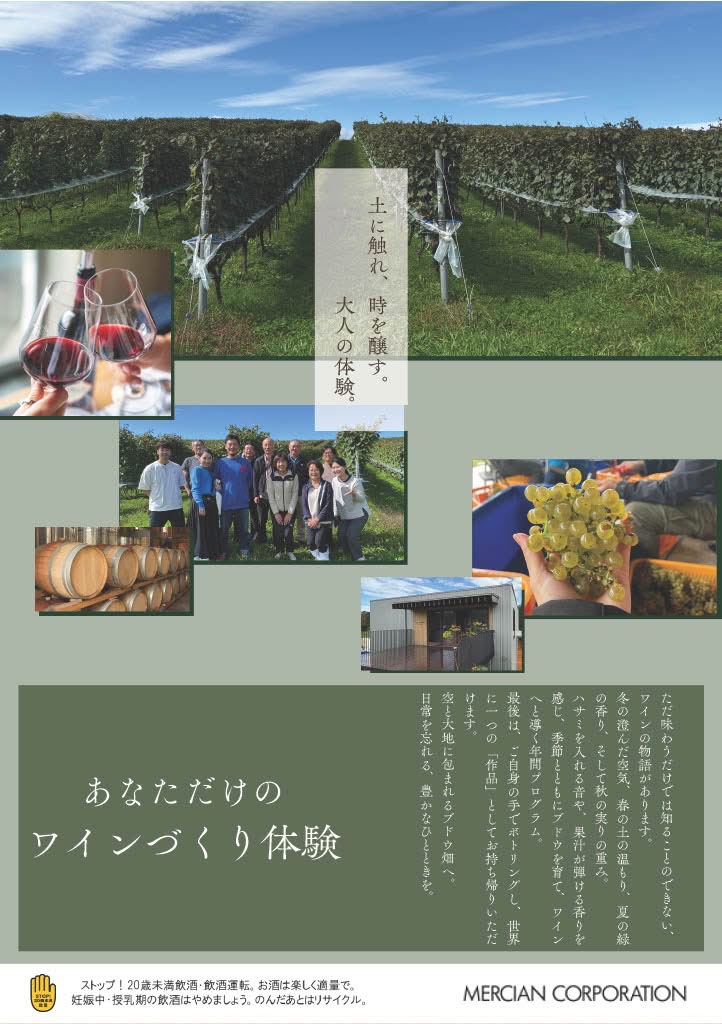
“Make Your Own Wine” is a hands-on program in which participants create an original wine under direct guidance from professionals. Launched last September, it is an unusual wine experience that allows drinkers to take part from the very first stages of production.
Contents
Create your own original wine under direct guidance from professionals through the “Make Your Own Wine” program.
Launched last September, this is a new kind of wine experience in which the people who will eventually drink the wine take part from the very first stages of production.
https://nihonwine.jp/enjoy-nihon-wine/event_report/hanamaki-winemaking-report202512/
https://nihonwine.jp/enjoy-nihon-wine/event_report/hanamaki-winemaking-report202512-2/
https://nihonwine.jp/enjoy-nihon-wine/hanamaki-winemaking-report202512-3/
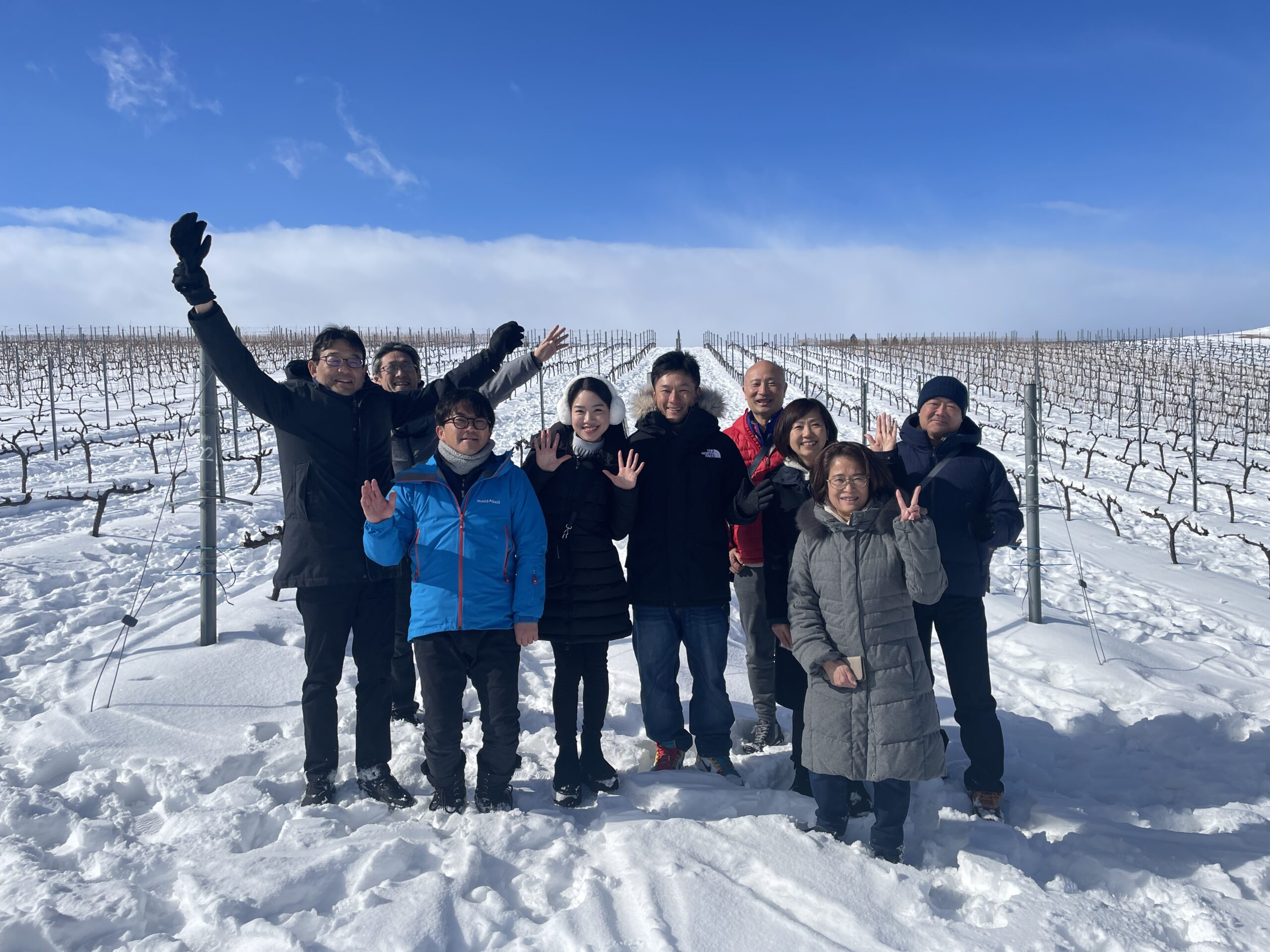
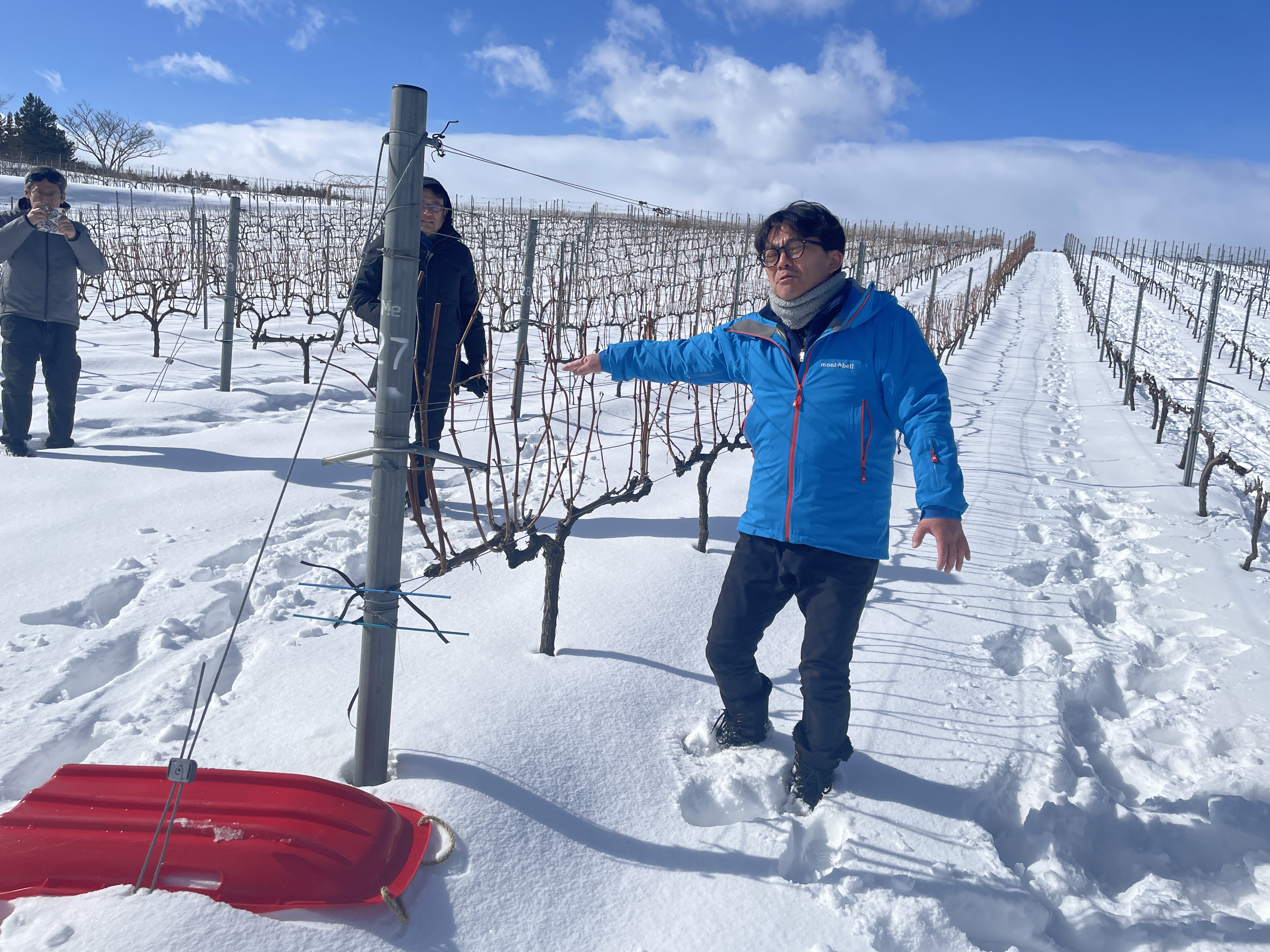
Hanamaki in Iwate Prefecture lies on the Pacific side and is not normally considered an area of exceptionally heavy snowfall. This year, however, was different. When I visited in early February, several days of heavy snow had left a deep layer of powder across the landscape.
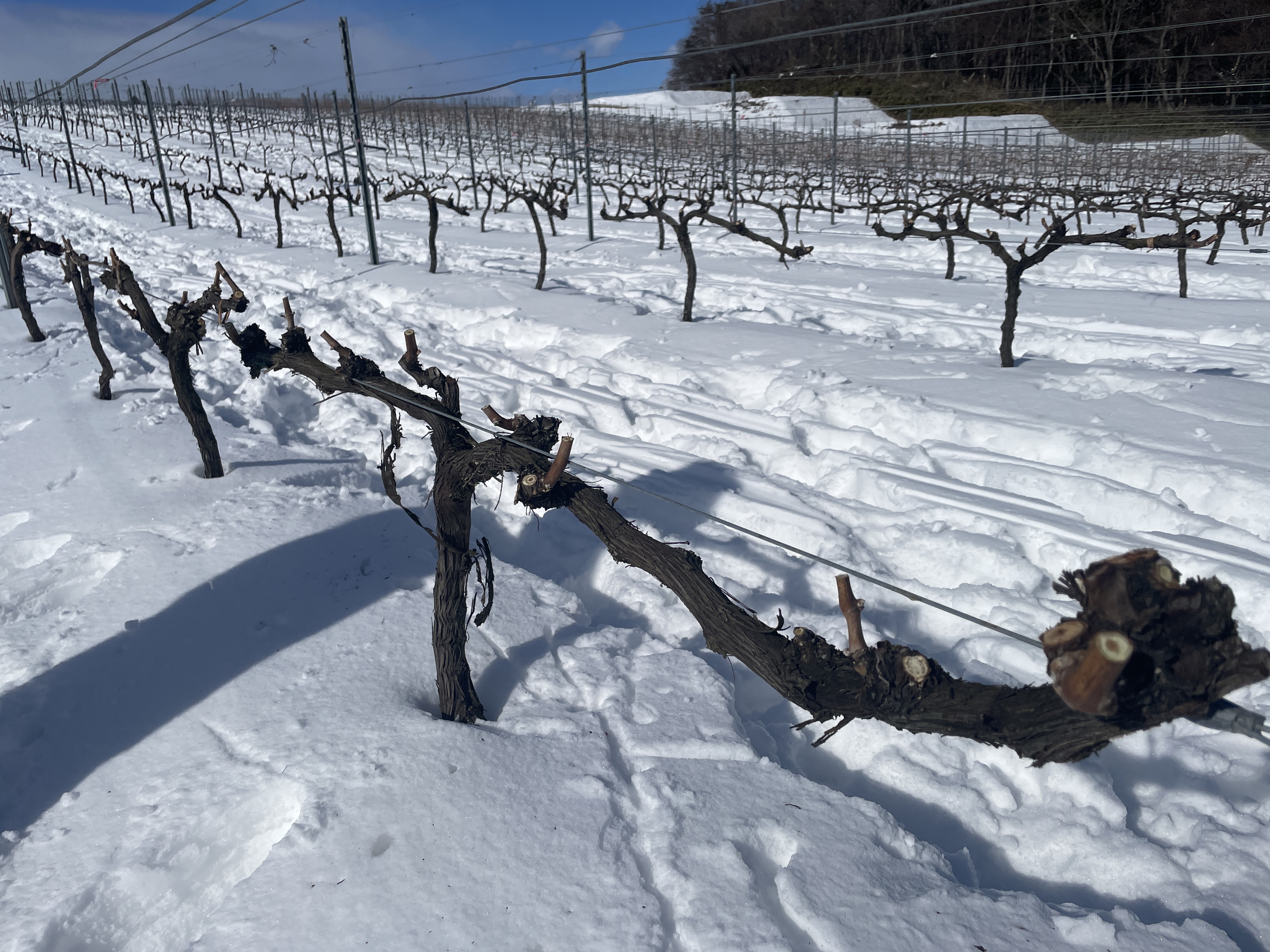
The vineyard I had photographed in Volumes 1 and 2 was now so white that it hardly looked like the same place. With sunlight glaring off the snow, we listened to an explanation of winter pruning.
CHAPTER 01
Preparing Petit Manseng for Bottling
The main work this time was filtration and bottling.
- Choose the bottle-and-cap combination (two bottle colors, with several cap colors available)
- Check the caps for foreign matter and remove any debris
- Filter the white wine first, followed by the orange wine
- Analyze sulfur dioxide levels
- Bottle the wine
We also learned that wine filtration can broadly be divided into three types.
- Diatomaceous-earth filtration, which handles coarser material well
- Depth filtration, often used as a finishing step in winemaking
- Membrane filtration, which can trap material down to the microbial level and comes close to sterilizing filtration
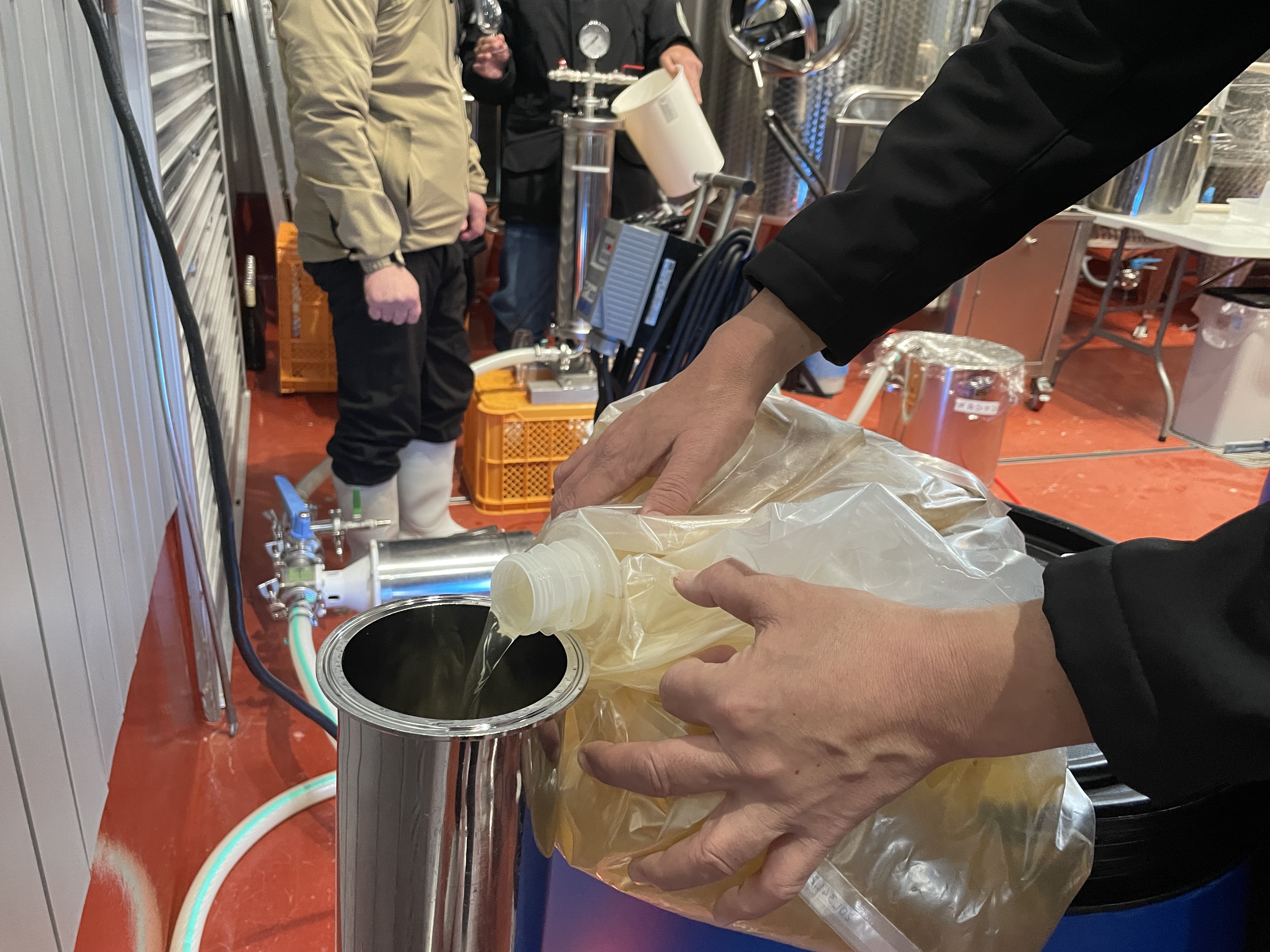
Because our batch was small, instructor Tamura brought in a compact depth filter for the final filtration.
We worked very carefully to rack the clear wine away from the settled lees and tartrate crystals so filtration would go as smoothly as possible. With such a small lot, the amount of wine absorbed by the filter matters proportionally more. There is a particular tension that comes from knowing, “We only have 30 liters.”
A Natural Refrigerator Softens the Sharp Edges of Acidity
When we tasted the white wine last December, it was strikingly tart. This time we checked it again after two months of cold storage at around -4°C. What we found were gritty crystals — in other words, tartrates. In our previous classroom session, we had learned the principle that tartaric acid crystallizes and precipitates at low temperatures, slightly softening the wine’s acidity. Actually seeing and touching that “acid in crystal form” this time made the lesson much more tangible.
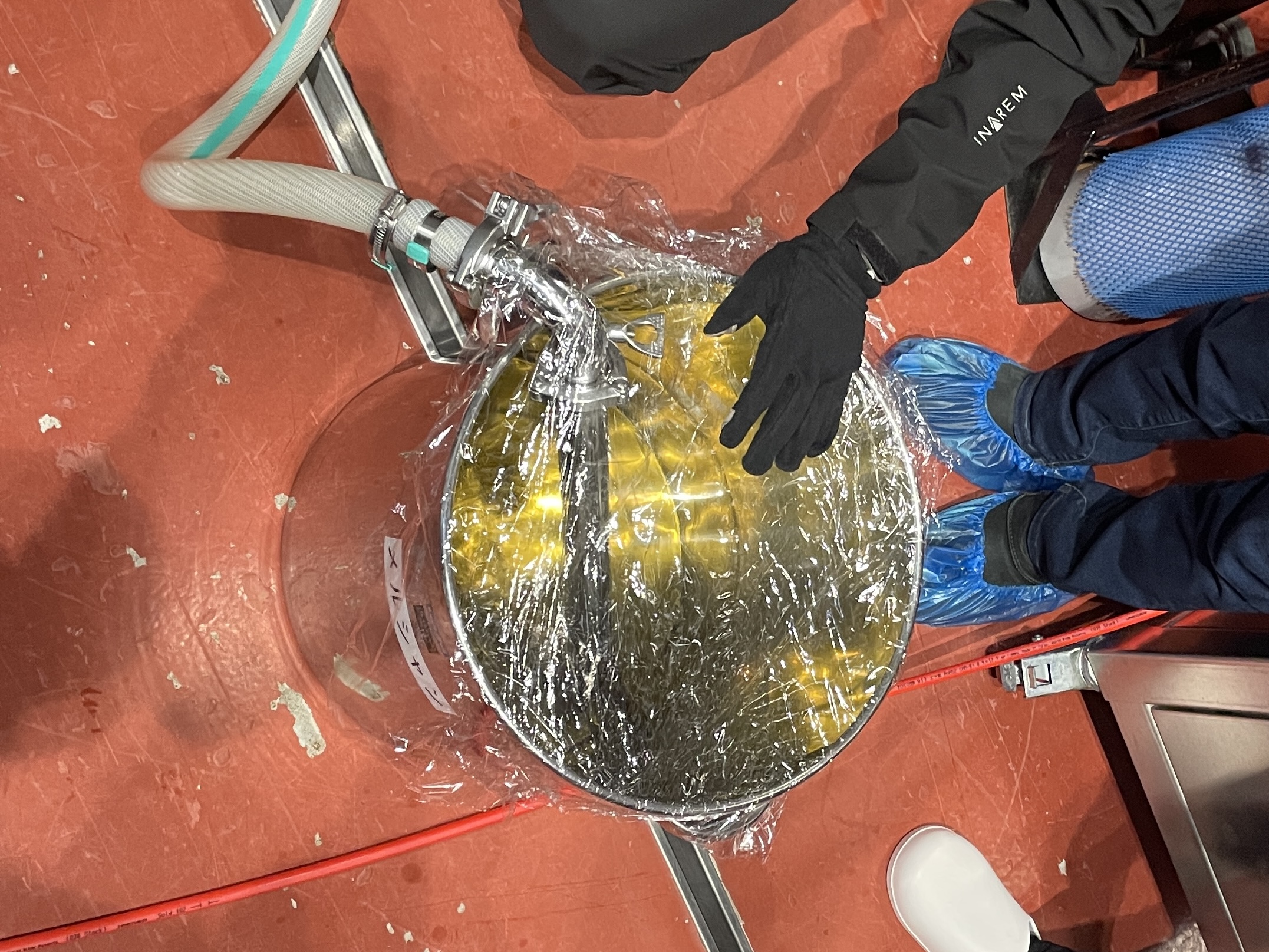
Then came the moment when the filtered wine began collecting in the stainless-steel tank. We had not been able to appreciate its appearance in the blue container that held the wine before filtration, but against the mirror-like stainless steel, the liquid suddenly looked brilliant and luminous. Instructor Tamura remarked that “a liquid that shines after filtration is something special,” and everyone immediately understood what he meant.
Another major question for all of us was how the wine had changed since our previous tasting. The acidity we had been watching had settled down, while fruitiness and savory depth had emerged. We were relieved to find it in a state we could all feel good about.
Bottling Is About Division of Labor — and an Obsession with Keeping Oxygen Out
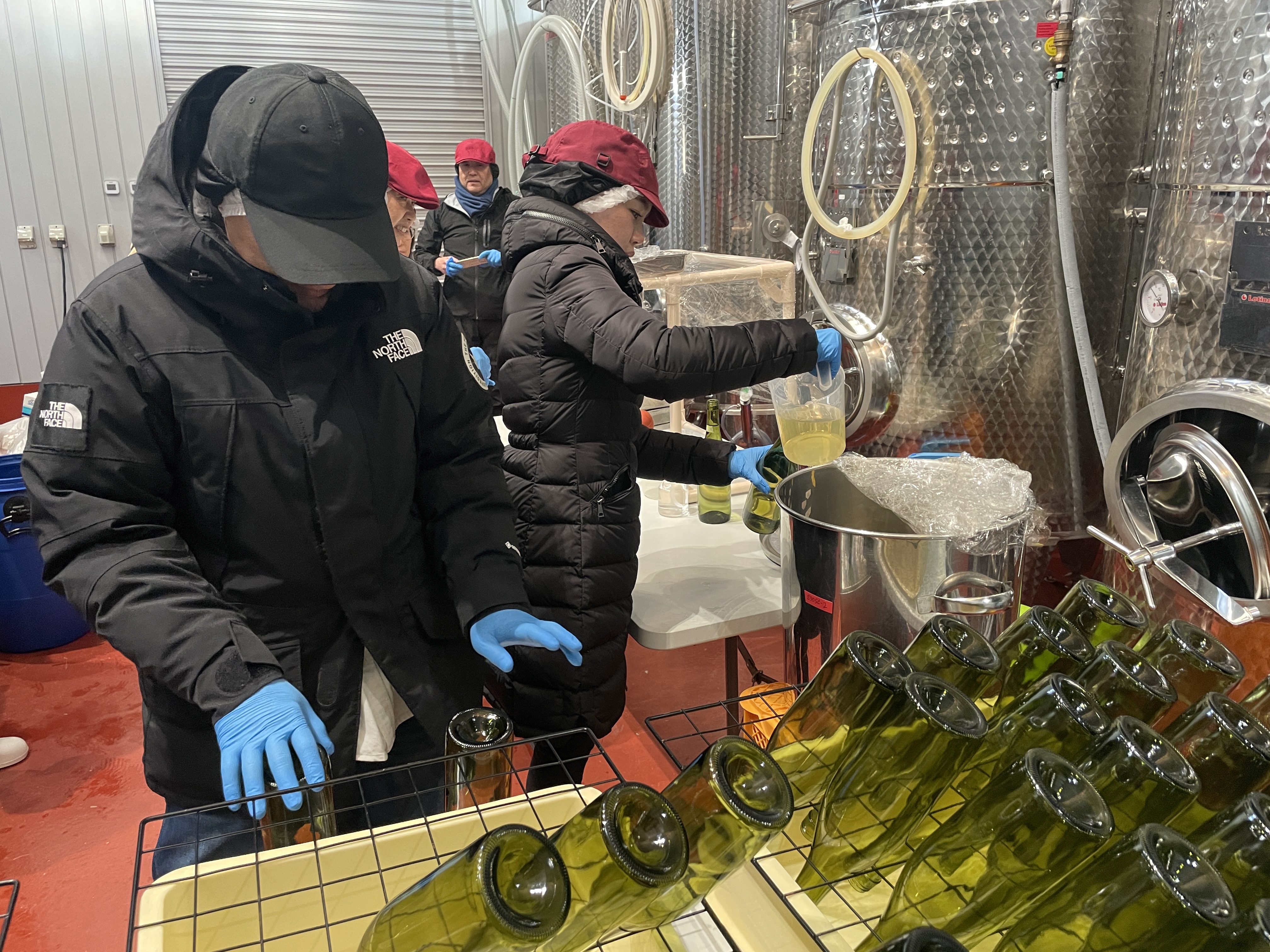
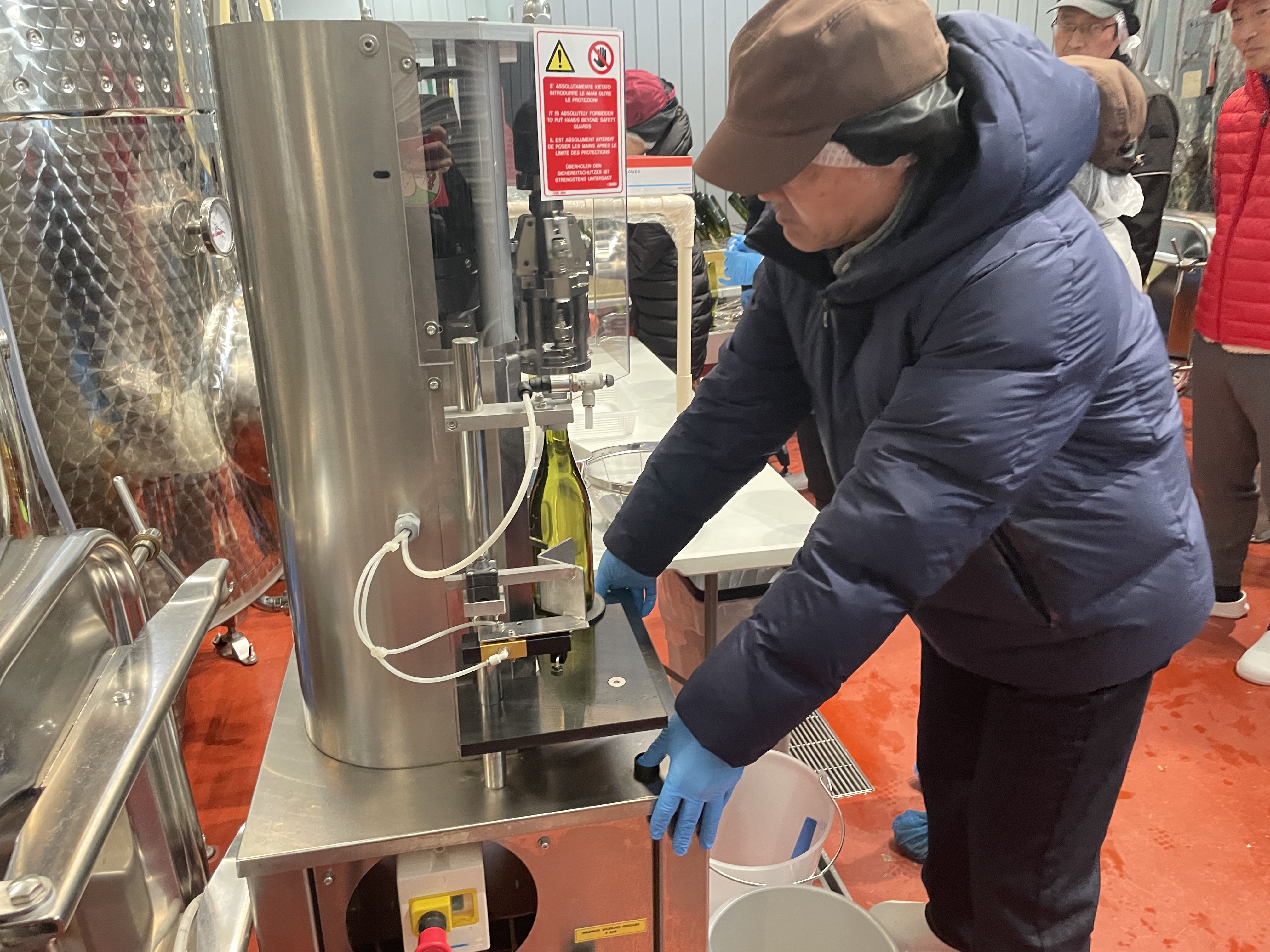
The final step was bottling together as a group. The process looks simple, but in practice there are many details that demand attention.
- Purge the air from each bottle with nitrogen using a dedicated machine
- Because the lot is small, adjust fill levels by hand rather than with an automatic measuring system
- Fine-tune the volume and wipe the bottle mouth to prevent mold and contamination
- Add nitrogen to the headspace again before capping
- With the capping machine, keep pressing all the way down; releasing midway can cause a failed seal
- Carefully arrange the finished bottles in baskets
The work was divided into six roles, and we rotated so that every participant experienced every step. One particularly interesting lesson concerned temperature and dissolved oxygen. Colder liquid holds more oxygen, so if care is not taken, sulfur dioxide — used to protect the wine from oxidation — can be consumed faster than expected. Seeing that principle reflected in the actual environment and in our own movements made it much easier to understand.
Another surprisingly deep subject in bottling was the relationship between “the law and appearance.” It is not enough simply to comply with the Liquor Tax Act and the Measurement Act. Individual bottles vary slightly, which means identical volumes do not always produce identical fill heights. The visual consistency of the finished bottles also has to be managed. Those beautifully aligned bottles we casually see on store shelves are not merely an expression of aesthetics. I came to understand that consistency in appearance is also part of the process of building trust.
CHAPTER 02
Looking Back on the 2025 Vineyard Season
We were also shown around the snow-covered vineyard after its preliminary pruning had been completed. Some varieties yielded more fruit thanks to favorable weather, while unusually high temperatures also brought a major outbreak of stink bugs, including several waves of infestation. Apparently, stink bugs can go through three or four generations in a single season. With some grape varieties increasing and others declining, Takahashi-san commented, “There are always trade-offs. Nothing is ever quite that simple.”
Terraced fields that had once been abandoned have now been fully prepared, and the vineyard is expected to expand next spring. By the time I visit again, the landscape may look different once more. Standing in front of the snow-covered vines, our group remembered what the same vineyard had looked like on our previous visit and took another group photo in the same style. It was another moment that made us keenly aware of how the seasons and nature keep changing.
CHAPTER 03
Pruning at Earl Paysan Winery
The main vineyard task in winter is pruning — deciding which canes and buds to leave for spring growth. At Earl Paysan Winery, pruning is not completed in one pass. Instead, the team works in two stages: preliminary pruning followed by final pruning. We happened to visit just after the preliminary pruning had been completed.
- Preliminary pruning: Rather than cutting long canes all the way back at once, which makes the later work more difficult, they are first shortened roughly around the middle.
- Final pruning: After checking dieback and the condition of each vine, the team decides exactly which buds to retain — perhaps one or two, depending on the vine.
Here, pruning too early can damage the buds, so the timing is adjusted while watching conditions closely. In regions with heavier snow, on the other hand, growers may prune earlier in order to lighten the canes and reduce the risk of the vines breaking under snow. Yet the best choice also depends on available labor, work planning, and the grower’s overall policy. Each vineyard ultimately has to choose the method that suits its own circumstances.
We also heard that growers may prune later in locations where late frost is a major threat, because they want to delay budbreak. It reminded me that one of the difficult aspects of farming is having to make flexible decisions based on a combination of factors — the realities of scheduling work, the behavior of nature, and much more.
CHAPTER 04
In Closing
During this visit to Hanamaki, we listened to an explanation of pruning in a snow-covered vineyard; saw and touched tartrate crystals as we learned how cold temperatures soften acidity; experienced the thinking behind filtration and the challenges of working with a tiny lot; and came to understand firsthand how seriously winemakers must take the risk of oxidation. Finally, we bottled the wine while trying to keep “as little air as possible” inside each bottle.
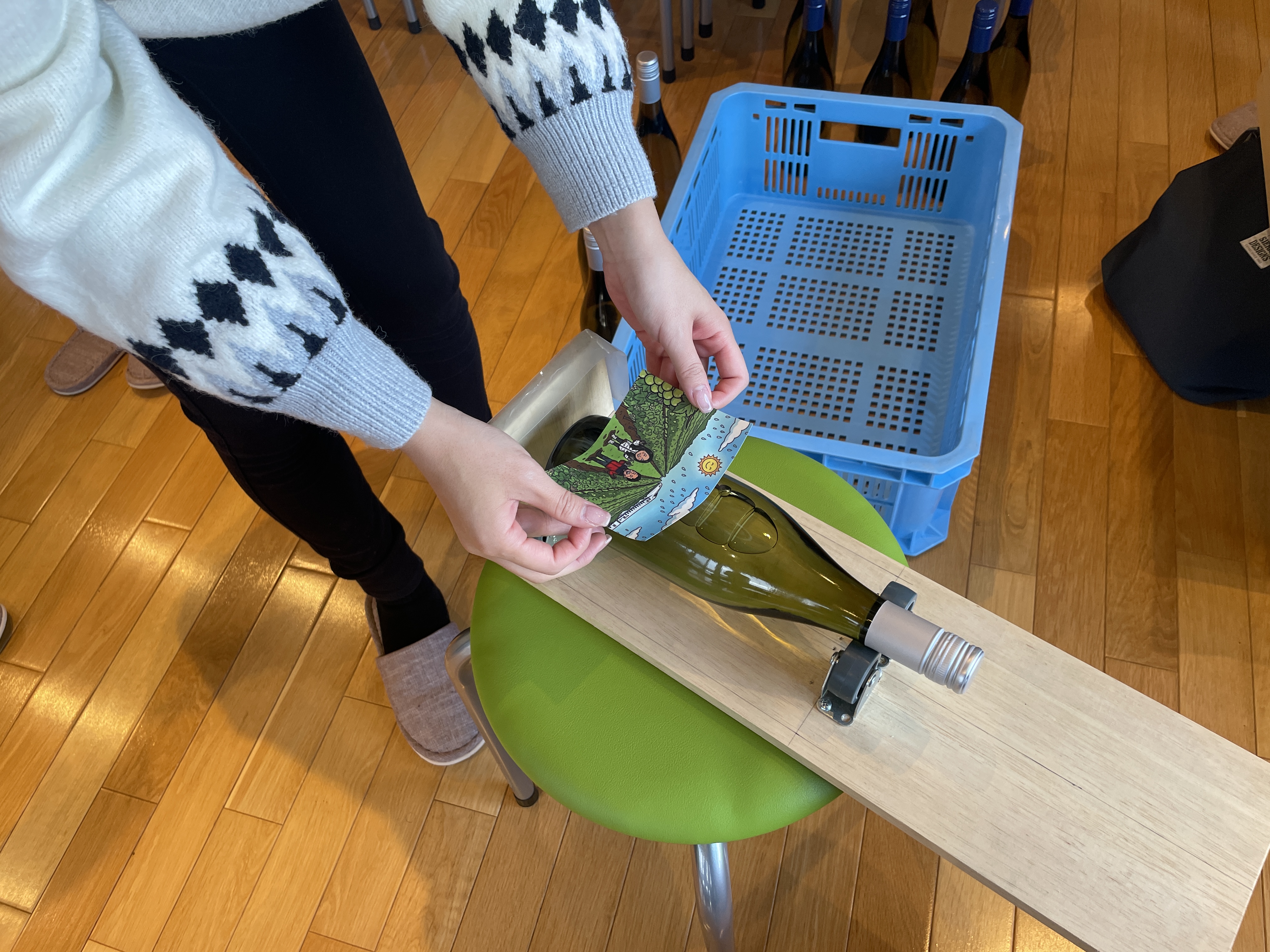
And at the very end, we applied the original labels we had designed ourselves. The wine was finally complete. Everyone took photos while imagining the day we would eventually open these bottles. Each participant then arranged shipment of one case to their home — six bottles of white and six of orange — bringing our “Make Your Own Wine” experience safely to a close. For the participants, the value was surely about much more than simply being able to say, “I made my own wine.” It was a chance to experience the winemaking process itself, the difficulty of agriculture, and the pleasure of working together with a group — something many of us rarely get to do outside our jobs once we become adults.
CHAPTER 05
Second Season of the “Make Your Own Wine” Experience
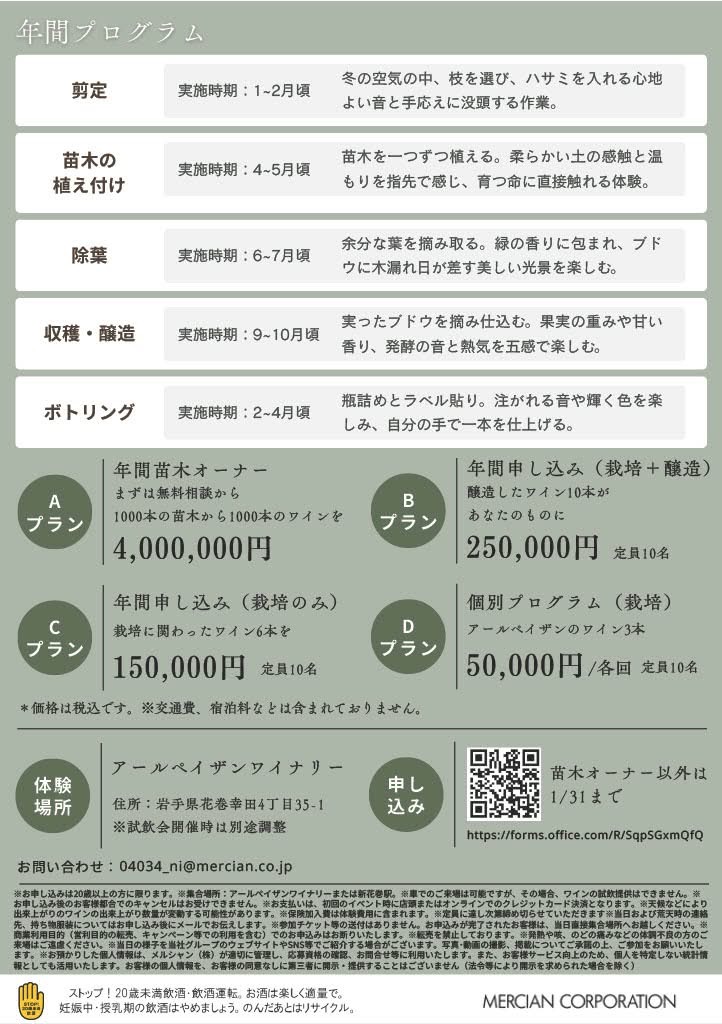
Applications are now open for the second season.
The schedule currently confirmed is as follows.
March 28–29: Pruning
May 9–10: Planting
If you have ever wanted to make a wine of your own — or if you know wine well but have never actually made it — there is no substitute for seeing and doing it for yourself.
If you are interested, I recommend considering an application soon enough to join the pruning session.
About the author
Stories covering the same region, newest first.
Wineries in this region
REGIONAL WINERIESRead → Know → VisitWineries in 岩手県. Find somewhere to visit.