
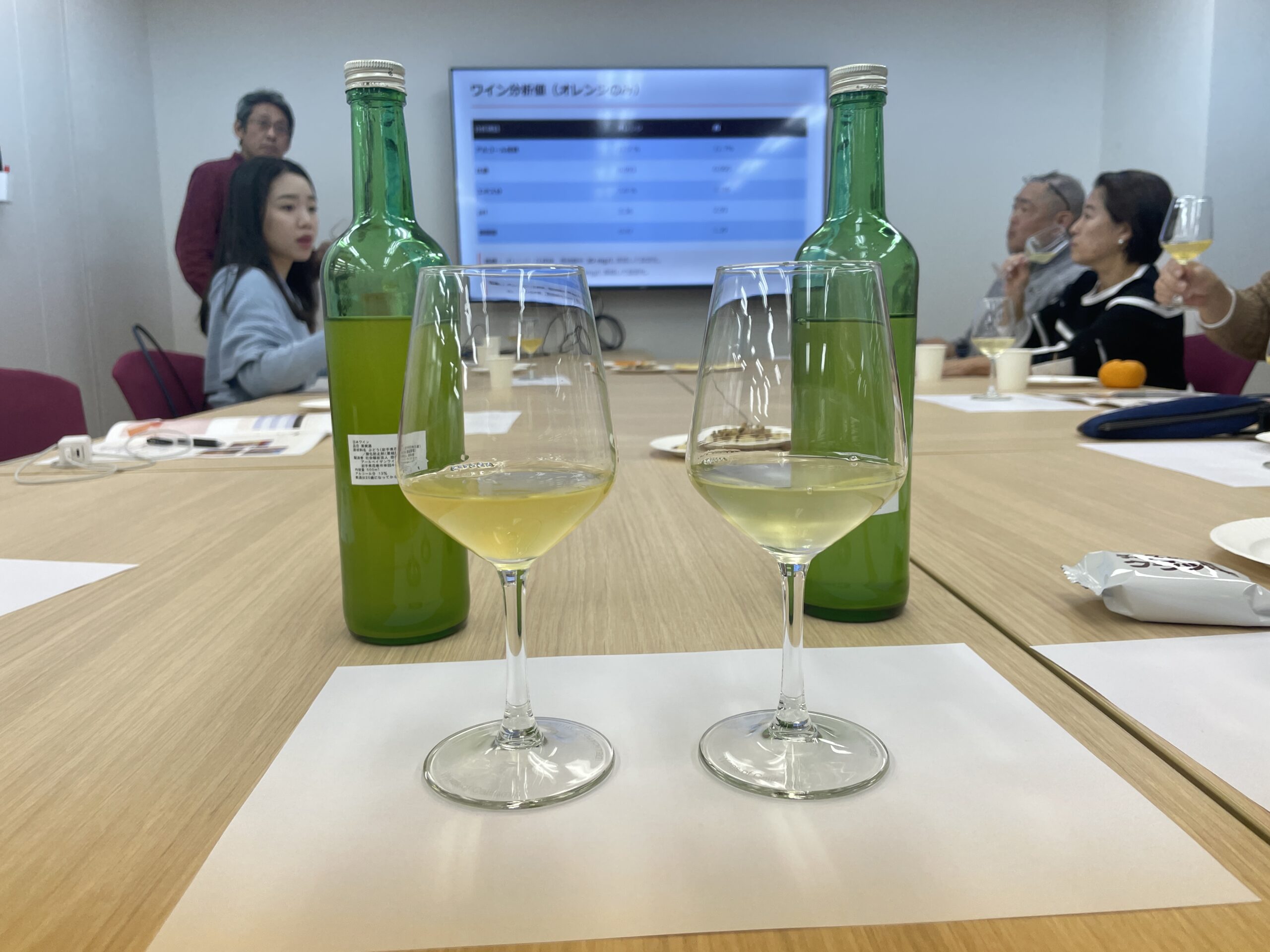
“Craft Your Own Wine” is a hands-on program in which participants create an original wine under direct guidance from professional winemakers. Launched in September, it is a new kind of wine experience that lets drinkers take part from the very first stages of production.
Contents
“Craft Your Own Wine” is a program that lets you make an original wine under the direct guidance of professional winemakers.
Launched in September, it is a new kind of winemaking experience in which drinkers become involved from the very first stage of production.
https://nihonwine.jp/enjoy-nihon-wine/event_report/hanamaki-winemaking-report202512/
https://nihonwine.jp/enjoy-nihon-wine/event_report/hanamaki-winemaking-report202512-2/
CHAPTER 01
Tasting—and a Meeting to Decide What This Wine Should Become
Everyone had been looking forward to this day, and naturally the entire group gathered at a venue in Tokyo for the tasting. This third step of the program had three main objectives.
1. Review what we had done so far: harvesting, sorting, crush/processing, measurements and analysis 2. Taste the two cuvées, a white wine and an orange wine 3. Discuss together how to finish the wines and how we ultimately wanted to present them to the world
【1. Reviewing the Previous Steps: Harvest, Sorting, Processing, Measurements and Analysis】 One of the key moments in this project came during sorting after our rainy harvest. Sour berries, green berries and fully ripened yellow berries were all mixed together, and removing the underripe fruit took a considerable amount of time. Then someone said, “If we have gone to all this trouble to clean up the fruit, why not try fermenting it on the skins?” That single suggestion changed what had initially been a juice-focused plan and opened the door to making an orange wine as well. A white wine, in which the juice is separated early, and an orange wine, in which the juice remains in contact with skins and seeds: this was the point at which we decided to create two very different expressions from the same grapes.
During the review, we also went over the analytical figures recorded at the time of processing.
- Before harvest the grapes were said to be around 24–25 Brix, but the reading dropped slightly after pressing; field readings can fall by roughly 1–1.5 points
- Specific gravity was relatively high at 1.095, suggesting a potential alcohol level of around 12.5–13%
- Turbidity was around 200, with roughly 200–300 being one benchmark for white wine
- YAN, the yeast-assimilable nitrogen available for fermentation, was low at 160. Because that creates a risk of fermentation stalling, an additional nitrogen source was added
Winemaking is sometimes imagined as a world governed by intuition, but looking at these numbers again reminded me just how much the work can resemble a science experiment, with every stage tracked through measurement.
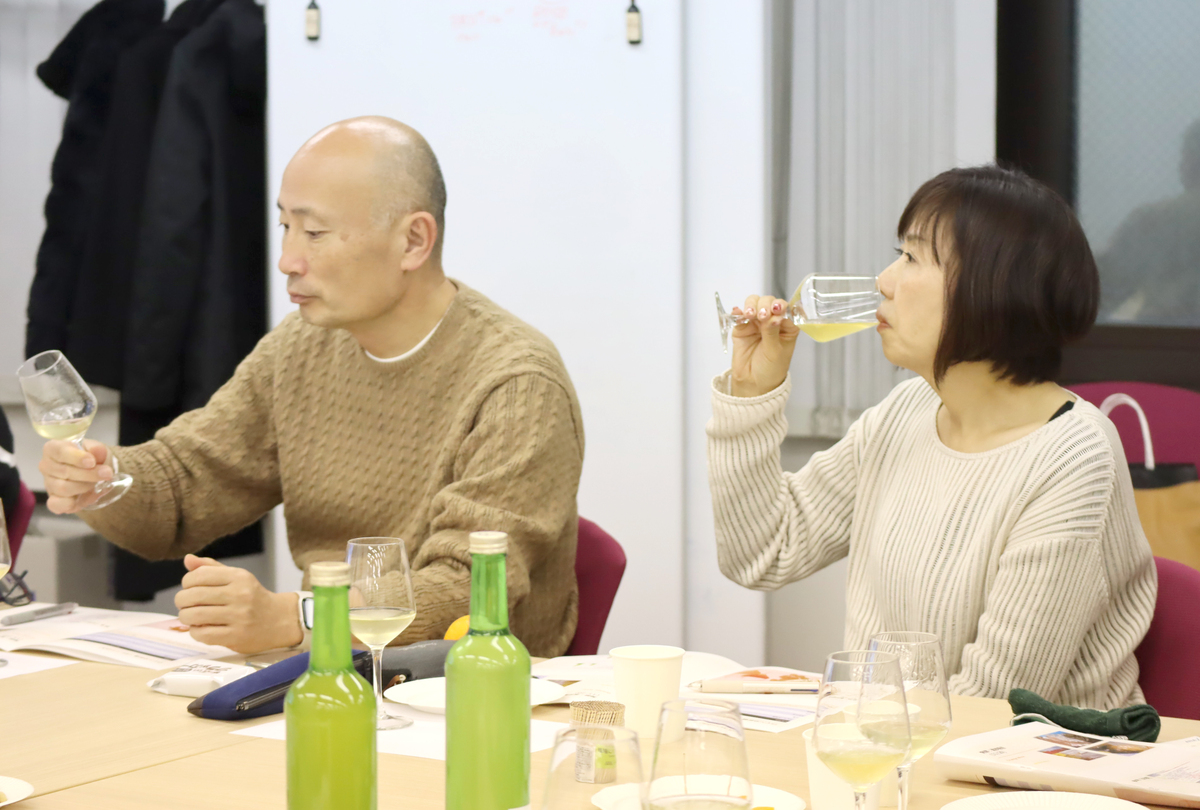
【2. Tasting the Two Cuvées: White and Orange】
We spent the first hour tasting and sharing comments. Tamura-san suggested, “First, let’s taste them. Then let’s play around and discuss whether we should bottle the white and orange as two separate cuvées, or blend them together.”
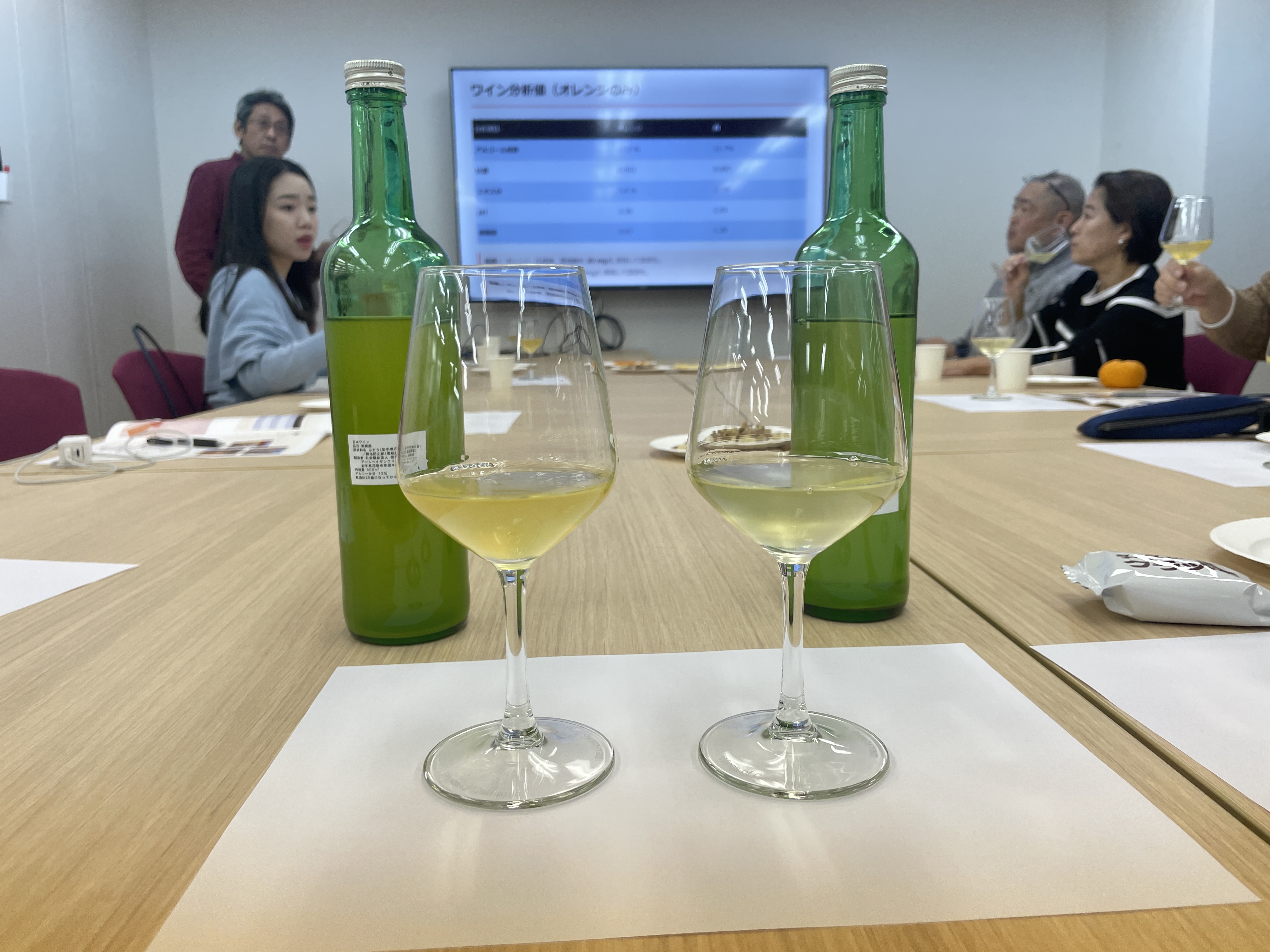
White: Razor-Sharp Acidity, but Beautiful Aromatics
The analytical figures also showed a pH of 1.29, and the wine was astonishingly tart. Comments included, “The acidity of the white lingers more in the mouth,” “There is a sense of sweetness and fruit, but the acidity dominates,” and “The aroma is wonderful. I can also feel a mineral character.”
Orange: Gentle, Savory and Made for Richer Foods
The orange wine drew especially positive reactions: “nutty and dried-fruit-like aromas,” “umami,” “a hint of tannin,” and “this would probably work even with a funky cheese.” What stayed with me was how people described its personality not as a big, sun-drenched orange wine, but as something calmer—evoking soil, the uneven contours of the vineyard and even the landscape before the site was developed.
Tamura-san then used a graph to explain how the fermentations had progressed. “The orange started fermenting on day two and finished in early November. The white, on the other hand, was slow to start. There was a period when we genuinely worried that it might not move forward at all, and fermentation continued into December.”
One possible explanation was that the orange wine could draw nutrients from the skins and other solids, while the white consisted only of liquid and therefore tended to have fewer available nutrients. Adding nutrients partway through was another possible option, but in the end the white simply followed a slow, extended fermentation.
【3. Discussing Together How to Finish the Wines and Bring Them to Market】
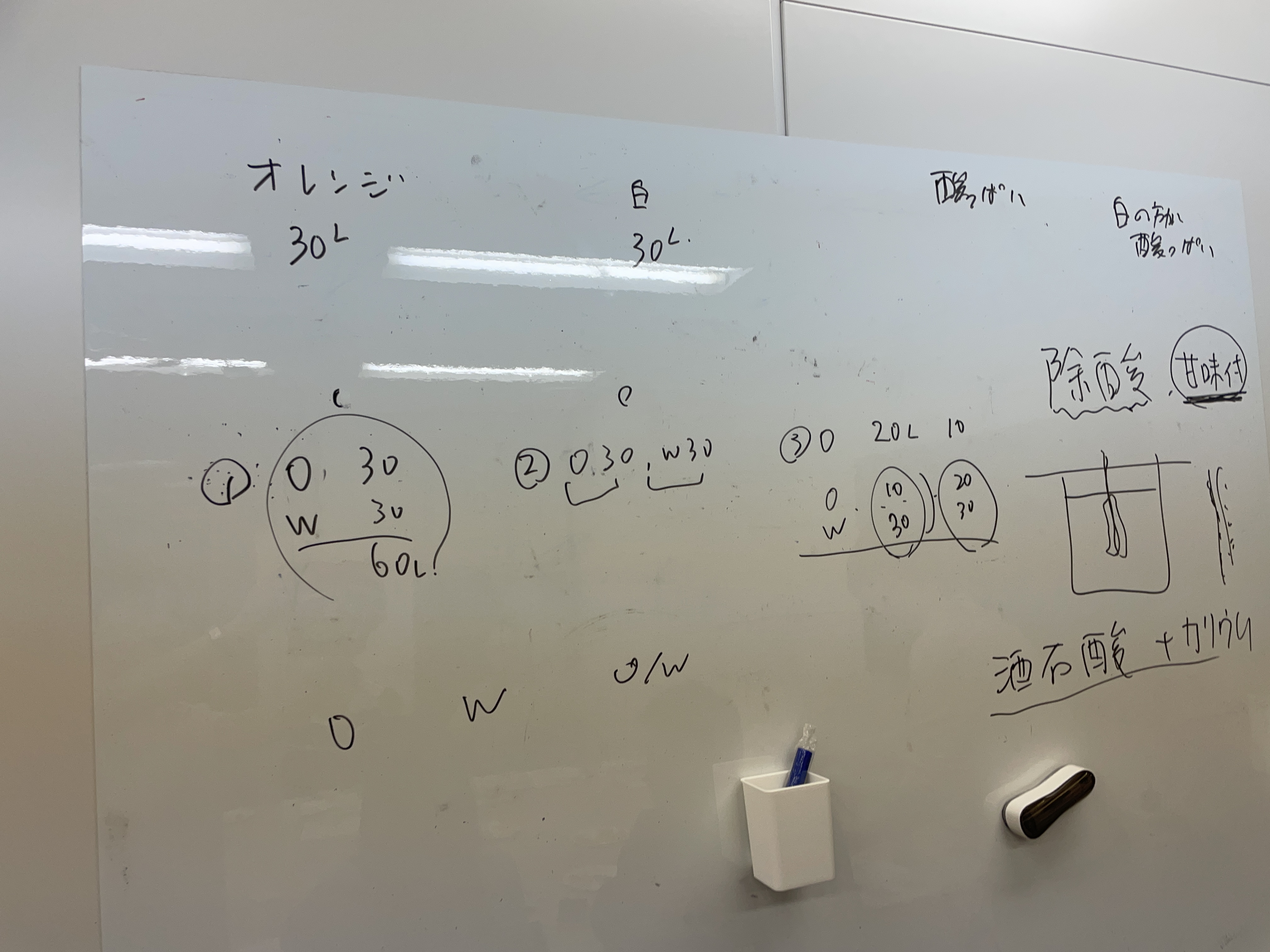
So what should we do with a wine this fiercely acidic? This was the discussion about how to finish it—the heart of this third session, you might say. Our ideas fell broadly into three directions.
1) Bring It into Balance Through Blending
We considered several blends: combining all 30 liters of white with all 30 liters of orange into a single 60-liter wine, or using the orange as the base and adding a smaller amount of white. When we actually tried 50:50 and 3:1 blends, the dilemma became obvious. Some combinations felt more balanced, but at the same time they seemed to lose some of their individuality.
2) Adjust Only the Acidity of the White
Three approaches were proposed for reducing the white wine’s acidity.
- Deacidification by chemically precipitating acids
- Cold treatment, chilling to around -4°C to precipitate tartrates
- Adding sweetness, although this increases microbiological risk
3) Let Time Do the Work
We also heard examples of wines whose acidity was almost numbing when newly made but softened after several years. That led to another philosophy: rather than intervening immediately, perhaps we could simply enjoy watching how the wine changed with time.
In the end, the decision we reached together was simple: for now, we would keep the white and orange as two separate wines.
- The orange already has an attractive personality and may become even better with refinement
- The white is very acidic, but it has potential; we want to see how it changes after cold treatment
- Once we blend them, there is no going back. Since this is our first experience, we want to follow the two wines separately for a while
In other words, we chose to raise the two wines side by side. A final blend will still be possible before bottling, but our conclusion was to first proceed with filtration, stabilization and cold treatment, then taste them again before making the final decision.
CHAPTER 02
Next: Bottling—and Then the Label
The next session, which will become Vol. 4 of this report, takes us back to Hanamaki for bottling. We expect to experience a long list of processes firsthand: washing bottles, gas purging, filling, capping, inspection and more.
And finally comes the label discussion. Because we made two wines, we decided that the orange would carry a common label shared by all participants, while each team could give the white its own personality. Keywords that emerged for the shared label included “Hanamaki,” “harvesting in the rain,” “the landscape before development,” and “the memory of the soil.” And because this is Hanamaki, someone even suggested borrowing from Kenji Miyazawa with a playful line along the lines of, “Undaunted by rain, undaunted by wind, we picked grapes in the rain.” By weaving these elements into the label, the final chapter will bring our memorable, truly personal wine to completion.
About the author
Stories covering the same region, newest first.
Wineries in this region
REGIONAL WINERIESRead → Know → VisitWineries in 岩手県. Find somewhere to visit.