
WINERIES
Your Very Own Winemaking Experience: Learning from Professionals at Art Paysan Winery Vol. 2
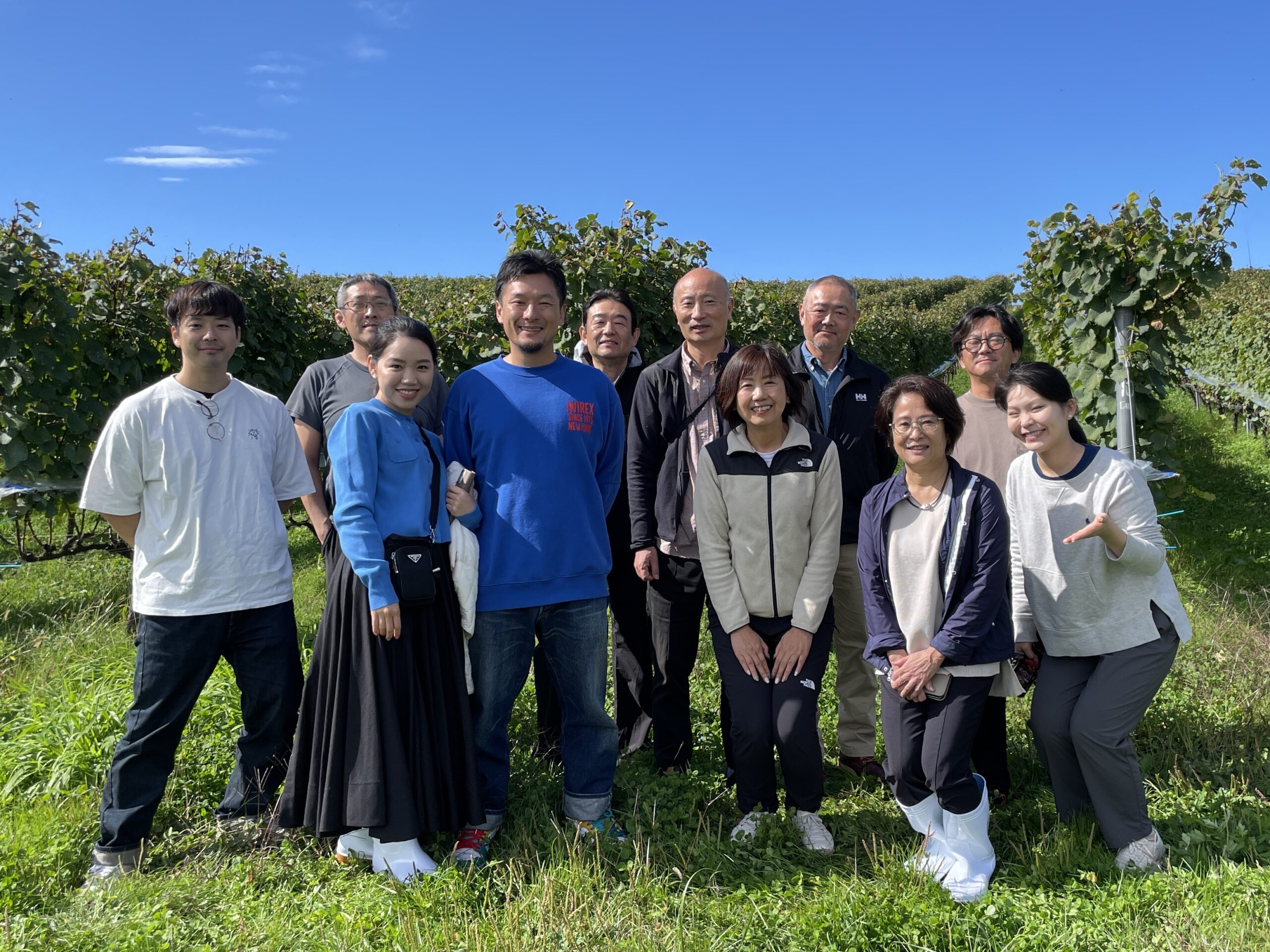
"Your Very Own Winemaking Experience" is a program where you craft your own original wine under the direct guidance of professionals. Launched in September, this innovative winemaking experience program represents a novel approach where drinkers are involved right from the very first step of production.
"Your Personal Winemaking Experience" is a program where you craft your own original wine under direct professional guidance. Launched in September, this winemaking experience program is a new trial where drinkers get involved right from the very first step of production.
https://nihonwine.jp/enjoy-nihon-wine/event_report/hanamaki-winemaking-report202512/
Now, this installment covers Day 2, continuing with the vinification process. We will experience and observe in considerable depth the process through which the grapes harvested and sorted the previous day turn into wine. We will also learn what changes are actually taking place inside the barrels and tanks.
Barrel Fermentation and MLF (Malolactic Fermentation)
First, separate from this project, Mr. Takahashi guided us to see Chardonnay that had already finished fermentation in the barrel cellar.
However, what had "finished" was only the alcoholic fermentation, and MLF (malolactic fermentation / lactic acid fermentation) was still slowly underway after that.
- Conversion from sharp malic acid → mellow lactic acid
- Period: Progressing slowly inside the barrel until around December
- After that, aged on the lees until spring
Here, we got to experience the work of bâtonnage (lees stirring). The lees are quite heavy, and it seemed like a real struggle, especially for the women. Doing this task every week really makes you realize what a physical job it is.
- For a portion of the white wine (Chardonnay), the lees are not completely removed,
- and the lees are stirred inside the barrels about once a week.
- This transfers the savoriness, smoothness, and body derived from the lees into the wine.
While "barrel fermentation" can also refer to transferring wine to barrels after fermenting in stainless steel tanks, this winery reportedly adopts "in-barrel fermentation from the very start." The reasons are:
- The oak aromas integrate more gently and elegantly.
- Oak, lees, and time naturally build layers of complexity.
We often hear the term "barrel fermentation," but this should give you a much clearer picture of when the wine goes into the barrel and what actually takes place inside.
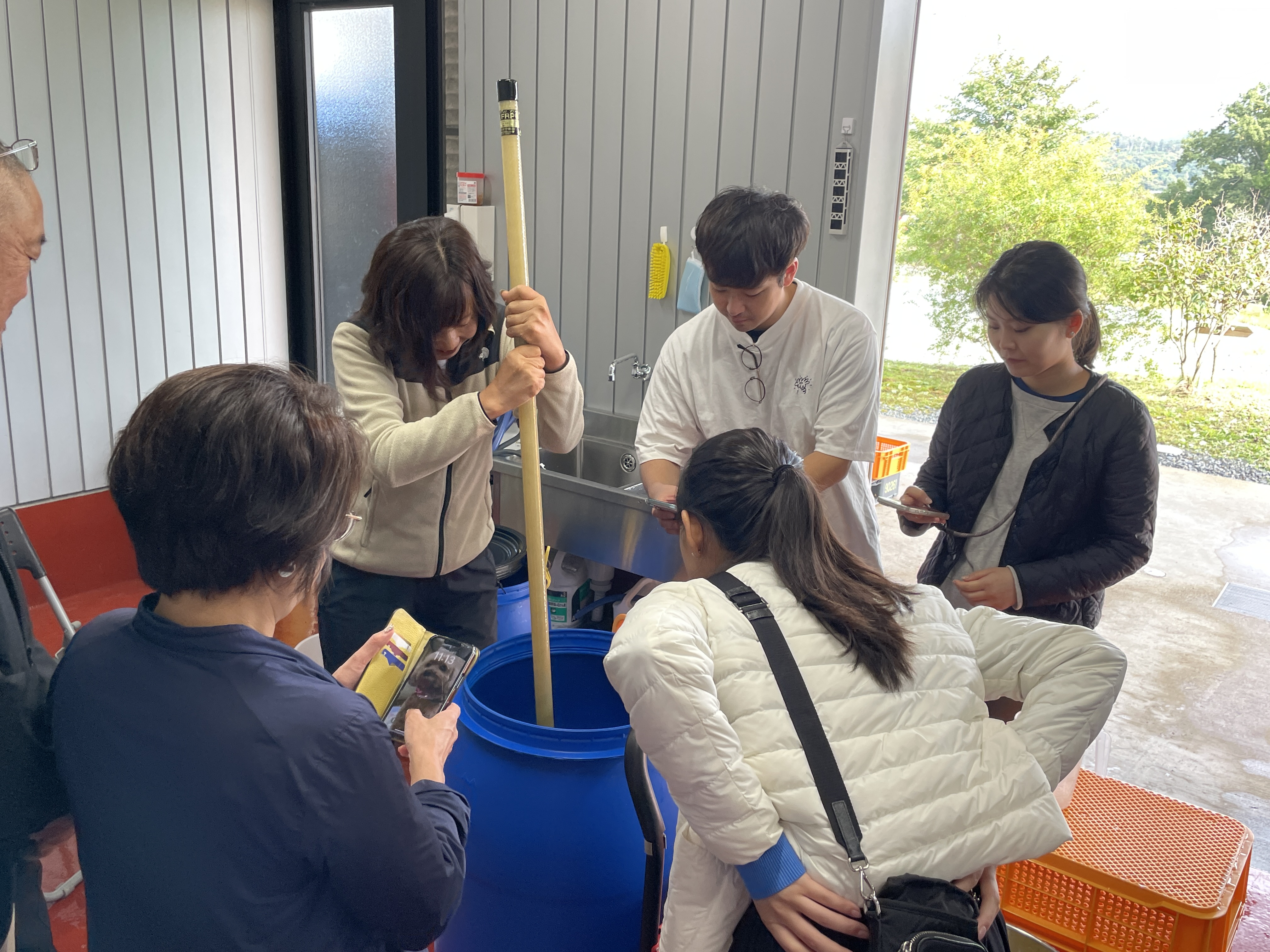
1. Drawing off the wine while avoiding the lees using a racking tube
Now, returning to "our wine." The wine that fermented in the tank yesterday had lees accumulated at the bottom.
How do we extract only the clear wine from this?
This is where theracking tube came into play.
- It is a tube whose height from the bottom of the tank can be adjusted using a scale on the outside.
- Assuming about 1 cm of lees had accumulated, the suction intake was set slightly above that level.
- It is inserted into the barrel to draw up only the clear liquid above the lees.
To check whether any cloudiness is getting mixed in along the way, you monitor it through an in-line sight glass (a transparent window). The moment cloudiness appears, you stop immediately. It is fascinating to see such finely adjustable tools paired with simple, analog vessels.
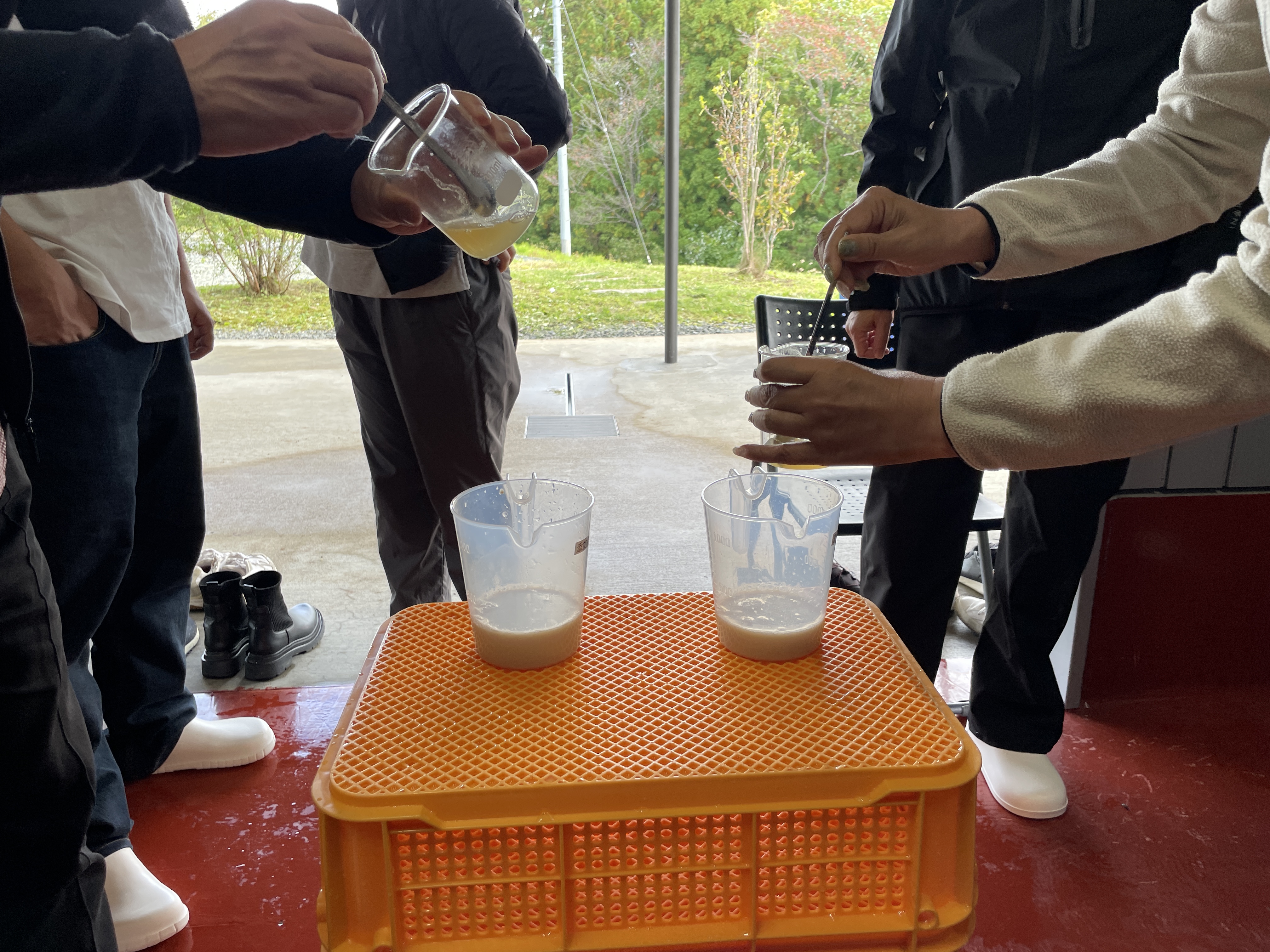
2. The Process of "Waking Up" Dry Yeast
Next, I got to experience the actual yeast addition (inoculation) process.
Looking at the steps, the procedure felt almost like a lab experiment.
- Dissolve dry yeast and nutrients in20 times their volume of lukewarm water at 37°C.
- Wait about 20 minutes for the yeast to awaken and start foaming.
- Gradually add wine juice to this, bringing the temperature down from 37°C to around 20°C.Lower in stages Gradually adjust the sugar level as well (do not add directly to high-sugar juice)
The reason is simple: to keep them from dying of shock.
- Abrupt temperature changes → Heat or cold shock weakens the yeast
- Adding directly to high-sugar liquid → Osmotic shock destroys the cells
While some colleagues drew comparisons to bread dough, it clearly showed that wine yeast is also quite delicate.
3. The Concept of YAN (Yeast Assimilable Nitrogen)
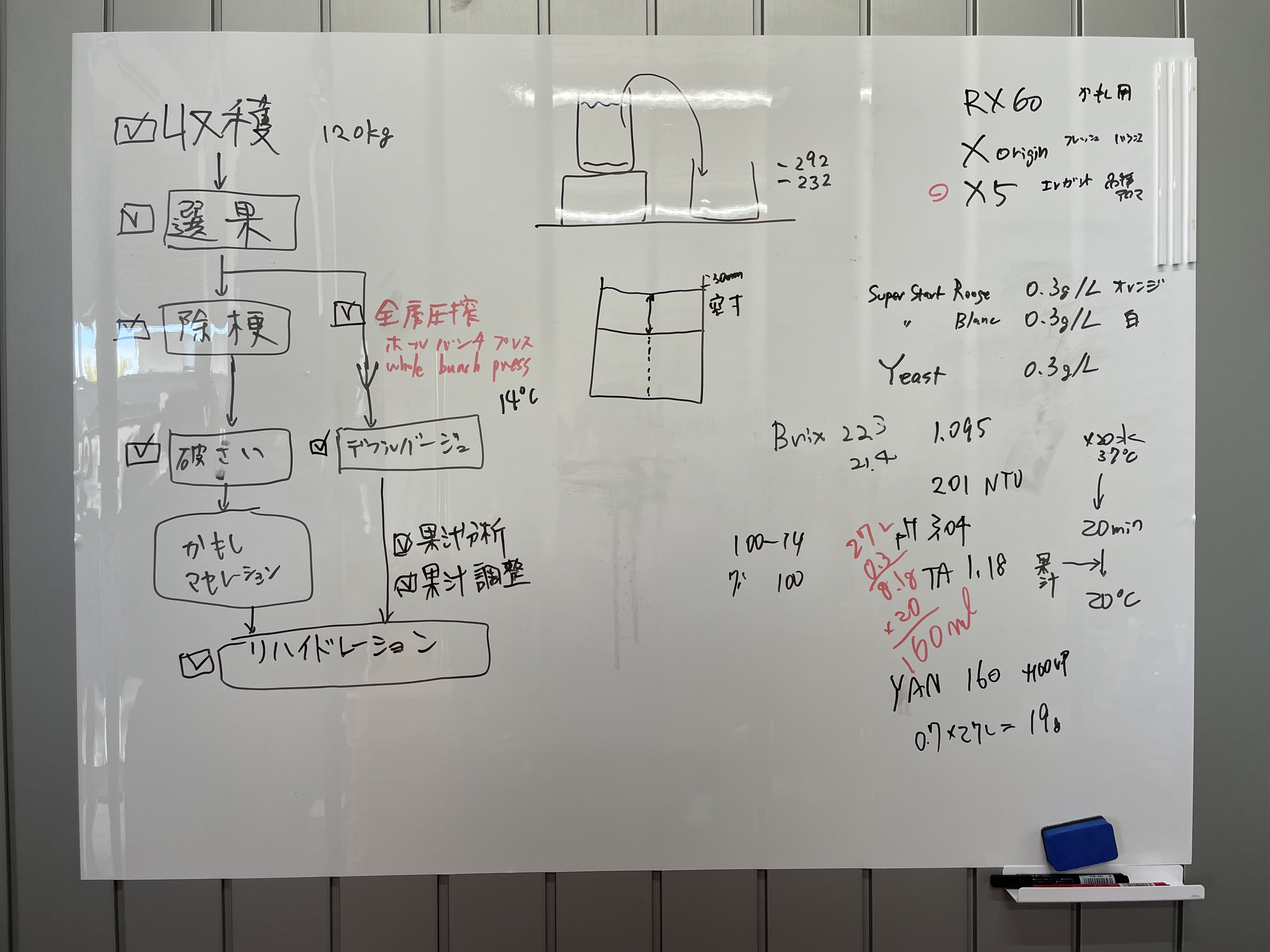
In the discussion on yeast nutrition management,YANwas also introduced as an indicator.
- YAN = Yeast Assimilable Nitrogen
(Amount of nitrogen in a form yeast can assimilate) - Target: 250–300 ppm is ideal
- This juice was at 160 ppm → a shortage of about 100 ppm
- Therefore, nitrogen sources such as ammonium phosphate are added to supplement it
So, what happens when YAN is low? You might be curious about that as well.
- Nutrient deficiency → Yeast gets exhausted midway through, making fermentation prone to stalling
- As a result, there is a risk of ending up with a faintly sweet wine with residual sugar.
For white wines, as it has less impact from sulfate ions than ammonium sulfate,ammonium phosphateis often used.
In addition, for white wines,glutathione-based preparationsare also used, aiming to prevent oxidation and maintain freshness.
Hearing all this, winemaking seems less like making wine and more like a "yeast health management project."
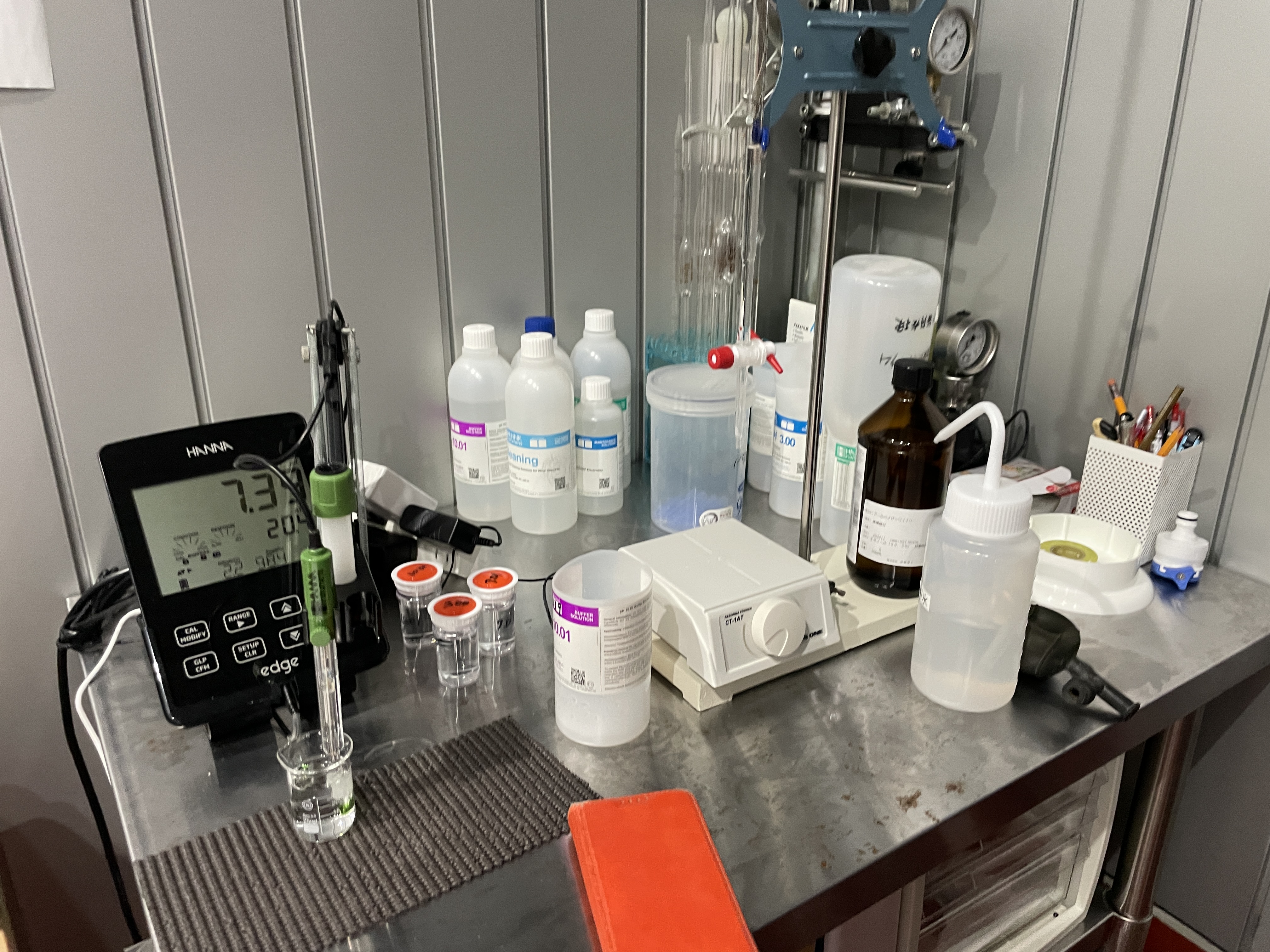
4. Specific Gravity, Turbidity, and Lab Work
For the juice prior to fermentation, I was able to take a few actual measurements.
■ Specific Gravity
Measuring the specific gravity of the juice using a hydrometer.
On this day, around 1.095—a fairly high figure.
- Specific gravity ≒ Indicator of sugar content
- Estimating the approximate final alcohol content (around 13%, etc.) from the sugar content
■ Turbidity (NTU)
The turbidity measured with a turbidimeter was 201 NTU.
Roughly speaking,
- Low turbidity → fewer nutrients, clean style
- High turbidity → more extracts and nutrients in the juice, tending toward a rich style
When aiming for a "powerful white" like Chardonnay, turbidity is sometimes set around 300 NTU.
This time it was 200 NTU, which was described as "just right, leaning toward elegant."
■ Role of the Analysis Lab
In the analysis lab, items such as the following are reportedly measured.
- pH
- Total acidity (titration)
- YAN (yeast assimilable nitrogen)
- Alcohol content (measured using a small still)
- Sulfur dioxide (volatilized and titrated using a dedicated analyzer)
While all of these could be measured in an instant with a fully automated analyzer, such equipment apparently costs millions of yen. Mr. Takahashi makes the effort, stating, "I take the time and effort to measure them manually."
Furthermore,"In fact, rather than the time spent pressing or adding yeast,I spend far more time washing up and conducting analysis," was a particularly memorable comment.
Contrary to its glamorous image, it really brought home that winemaking is an accumulation of "data" and "unglamorous work."
Winemaking Summary: What Day Two Revealed About Behind-the-Scenes Winemaking
What I felt through this two-day experience was that
- fermentation and aging progressing inside the barrels rely heavily on numerical management, not just sensory judgment.
- Yeast is not something that "will do its job on its own if left alone"; we need to properly manage its temperature, nutrients, and environment.
- Because a small mistake can ruin an entire winemaking process that happens only once a year, relying solely on "intuition" is not enough, andanalysis and reproducibilityare essential.
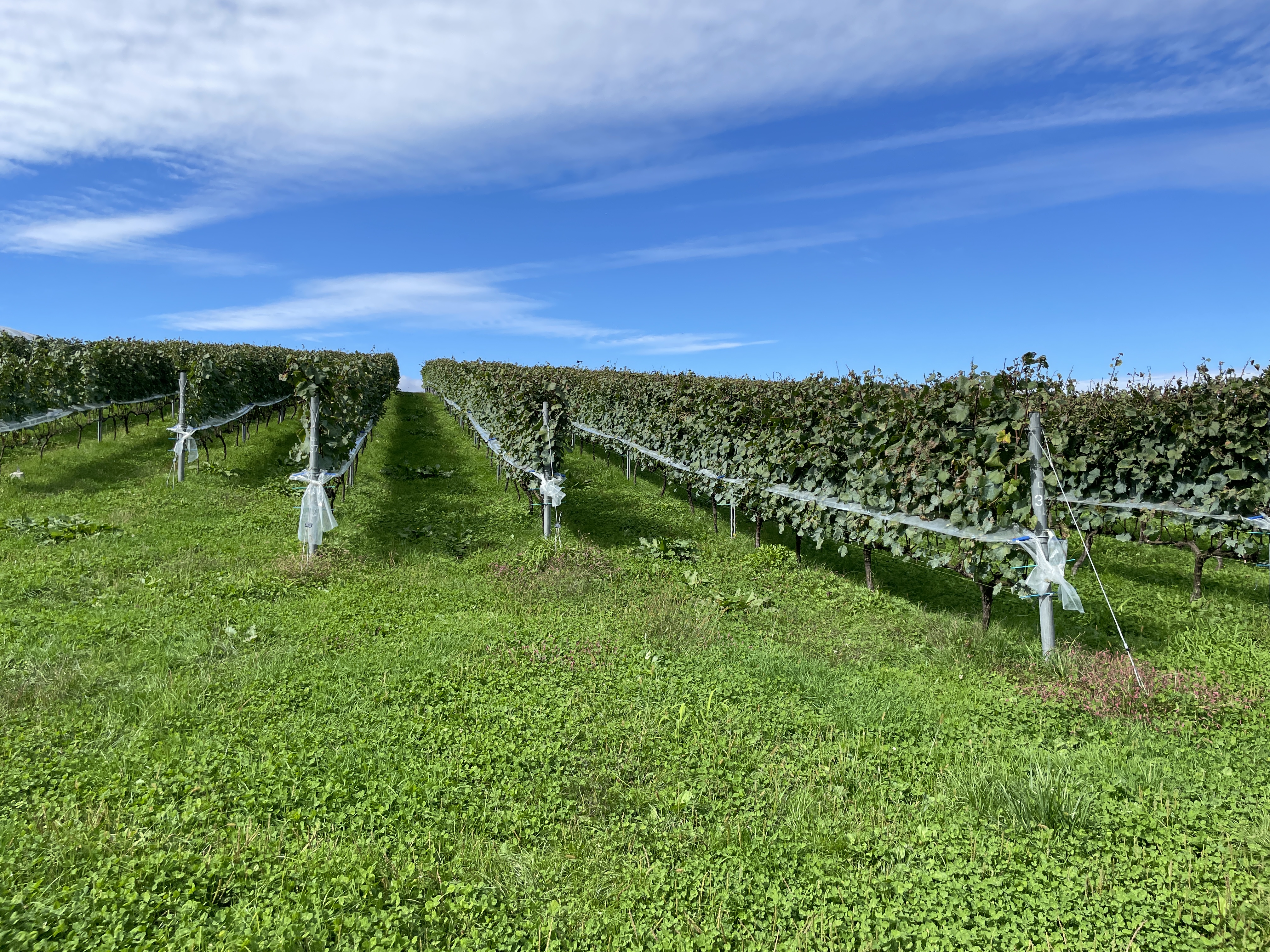
Vineyard Tour: Trellis Training and Vineyard Development Combining "Welfare × Wine"
I was also given a tour around the vineyards. Planted here are Cabernet Merlot, Gewürztraminer, Muscat Bailey A, and other varieties.Everything is trellis-trained.
The organization behind this vineyard is a social welfare corporation, and the primary work is carried out by staff members with disabilities employed here. The reason for standardizing on trellis training is 'to simplify operations and make the work manageable for anyone.'
By establishing clear rules for vineyard tasks, they have built a system where duties from pruning to harvesting can be reliably delegated. As a result, every single row is exceptionally neat and well-maintained.
The vineyard site was originally a former rice field abandoned for roughly 20 years, with current plantings at about 0.8 hectares (with plans to expand to a 2.5-hectare scale in the future).Without using chemical fertilizers or herbicides, they manage the land with the approach of returning nitrogen to the soil by leaving grass tall and encouraging legumes like clover. Although the elevation is not particularly high at around 120 meters, the south-facing clay slopes produce Chardonnay and Merlot, as well as Gewürztraminer and Muscat Bailey A, with quality exceeding expectations.
An aging population and abandoned land, social welfare and employment, and wine grape cultivation.
This vineyard may serve as a model case for seamlessly connecting these respective challenges.
CHAPTER 01
Participant Feedback
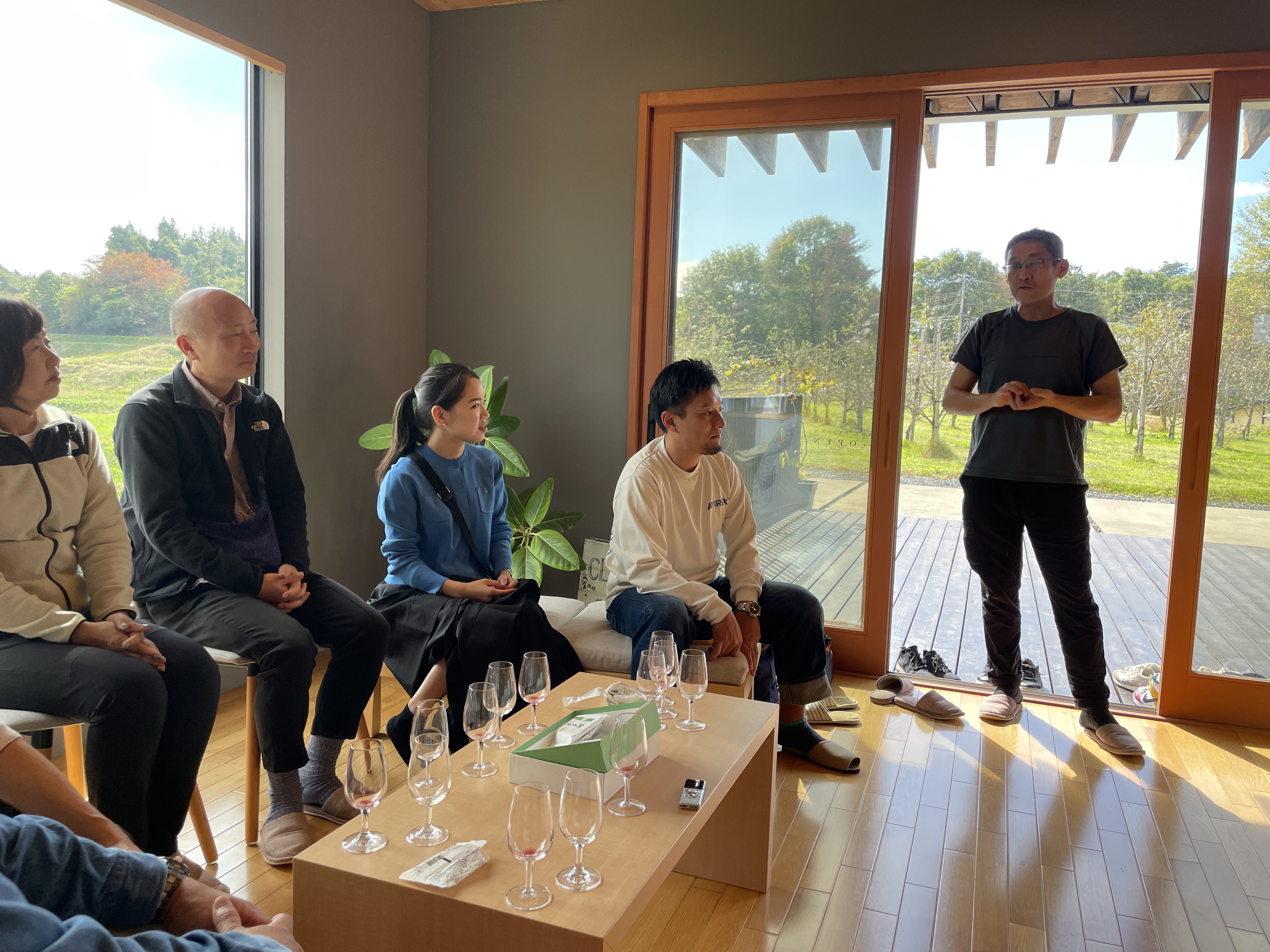
After the two days concluded, participants shared impressions such as these:
- "Even for processes I thought I understood from books and articles, actually seeing them and working with my hands made me realize that seeing is believing."
- "Being able to experience not just the harvest, but also sorting, destemming, pressing, yeast inoculation, and analysis gave me a real sense that we had crafted our own wine."
- "Learning that the wine I usually just drank is built on chemical management and a buildup of detailed measurements made me want to savor every single drop even more attentively from now on."
- "Being able to experience the entire process from picking the grapes to putting them in the tank—something you could almost never do in Tokyo—became my fondest memory."
By learning that behind the act of 'drinking a glass of wine' lies a buildup of post-harvest labor, barrels, yeast, numbers, analysis, and decision-making, it seems to have been an experience that inspired them to appreciate wine even more deeply.
How will the white and orange wines crafted this time turn out? Leaving the rest to Mr. Takahashi, everyone is eagerly looking forward to their reunion with the wines after bottling.
About the author
Stories covering the same region, newest first.
Wineries in this region
REGIONAL WINERIESRead → Know → VisitWineries in 岩手県. Find somewhere to visit.